Crypto debit cards for UK residents: who takes you, fees and tax
By GetQuids· Last verified: 22 November 2026 (HKT)· 13 min read
Which crypto debit cards on our list accept a UK address, what a purchase in pounds costs, how you top up, what the FCA register says about each firm and when HMRC counts a card payment as a disposal.
Ad / referral links — we may earn a bonus when you sign up.
Investing involves risk. Prices can go down as well as up and may become worthless. This is not investment advice.
How a crypto card pays a UK bill
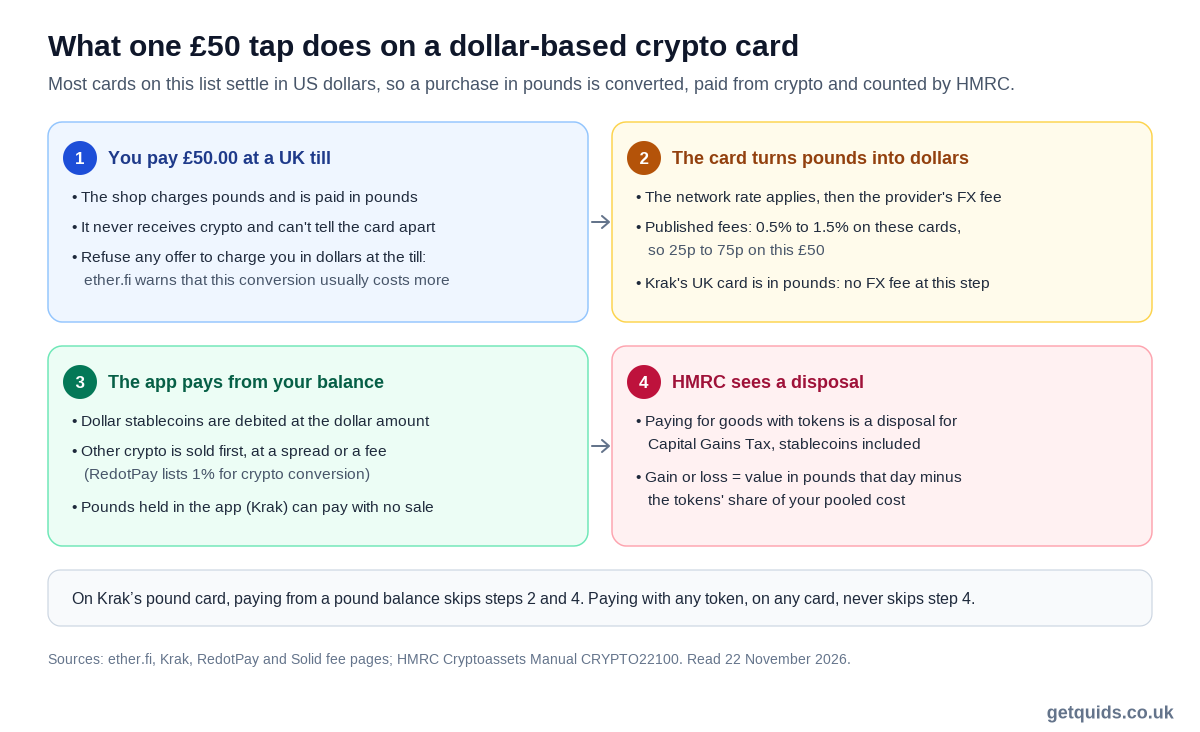
The card is issued by a payments company under a Visa or Mastercard licence and linked to an app that holds stablecoins or other crypto. When you pay, the app debits or sells crypto and the issuer pays the shop in ordinary money. The shop never sees crypto.
Two things follow for someone spending in pounds. Most cards on this list run in US dollars, so every UK purchase is converted and the provider adds an FX fee. And when tokens fund the payment, HMRC counts it as using tokens to pay for goods: a disposal for Capital Gains Tax, even if the token is a dollar stablecoin.
Custody decides who can freeze or lose your money. ether.fi describes its Vault as non-custodial: a Safe smart account whose signing key is generated and kept in Turnkey's secure enclaves and works only when you authenticate. Neither ether.fi nor Turnkey can sign for you, though you can't export the private key yet. Solid calls its wallet fully self-custodial, secured by passkeys, and says not even Solid can move your funds. RedotPay's terms name Red Dot Trust Limited, a Hong Kong company, as custodian, and Krak sells assets from the balance it holds for you. Self-custody removes one company that could fail; smart-contract bugs and a lost login remain your problem.
Which cards on our list take a UK address: checked 22 November 2026
| Card | UK in the provider's own rules | Card currency and issuer | Who holds the money | Check before applying |
|---|---|---|---|---|
| ether.fi Cash (Visa) | UK listed for virtual and physical cards, subject to identity checks | US dollars; issued by Third National under a Visa licence | Non-custodial Vault (Safe smart account, key held in Turnkey's secure enclaves; key export not yet available) | Core includes one virtual card ($10 in some regions); a physical card costs $50 on Core |
| Solid (Visa) | UK named among the 69 card countries | US dollars; new cards come from Wirex since Rain-issued Solid cards stopped working on 20 November 2026 | Self-custodial wallet secured by passkeys (Solid says it can't move your funds); operated by Fuse Network Ltd in Gibraltar | Existing users re-verify for the Wirex card. Solid doesn't name the Wirex company issuing UK cards; the app shows what applies to you |
| Krak Card (Mastercard) | Card open to residents of the UK, EEA and US. Krak's referral programme excludes the UK | Pounds for UK cardholders; issued by Monavate Ltd | Your Krak account balance; Krak sells assets in your chosen spend order to pay | Put pounds first in the spend order, or block crypto, if you don't want each purchase to sell crypto |
| Pulsar Money | UK on the card application list (73 countries) and on its USD (ACH) and EUR (SEPA) account lists | Issuer named in the card terms and feature schedule shown before you order | Depends on the wallet set-up; the card provider may pull or convert value from a linked smart account | Fees and FX markup appear in the app; Pulsar publishes no fixed percentages |
| Plasma One (Visa) | UK not on its prohibited or restricted lists; a separate notice for UK users applies | US dollars; the terms name Stripe Payments UK Ltd as a UK issuer, while Plasma's site footer names Rain | Plasma says it is not a bank and that stablecoin balances are not deposits | Standard is a virtual card only; a physical card needs Premium ($600 a year) or Platinum |
| RedotPay | UK not among the 43 places on its card restriction list | US dollar or Hong Kong dollar card; issuer not named on the pages we read | Custodial: its terms name Red Dot Trust Limited, a Hong Kong company, as custodian | Virtual card $10, physical card $100. Its terms say promotion outside Hong Kong may need a licence and that you sign up on your own initiative |
"UK listed" means the provider's own country page names the UK; approval still depends on identity checks. Where a provider publishes only an exclusion list, the UK not being on it is not a promise that a UK address will pass. Dollar prices are the providers' own.
The rest of our crypto card list, for a UK address
- Cashi: excludes only US residents and citizens and says it serves more than 100 countries without listing them; the app confirms your country during sign-up.
- Infini: the UK isn't on its personal identity-check restriction list, but Infini excludes the UK from the products it runs through Lead Bank and Banking Circle.
- SafePal: its Mastercard comes with a Swiss IBAN account run with Fiat24, and Fiat24 says it is not accepting new individual clients because of maintenance work.
- Not open to UK residents: Tuyo lists the UK as a platform-wide prohibited jurisdiction; DeCard is only for residents of nine Asia-Pacific countries.
- Avici: its card region list doesn't include the UK, and Avici says unlisted countries are not automatically eligible; its support team confirms availability.
- Couldn't confirm: KAST keeps its restricted-country list behind a sign-in; Hyperbeat Pay lists "Europe" without naming the UK; Jupiter's card documentation says eligibility is confirmed during identity checks.
What a purchase in pounds costs, and how money gets in
| Card | Card cost | Fee on a purchase in pounds | Top-up routes | Cash machines |
|---|---|---|---|---|
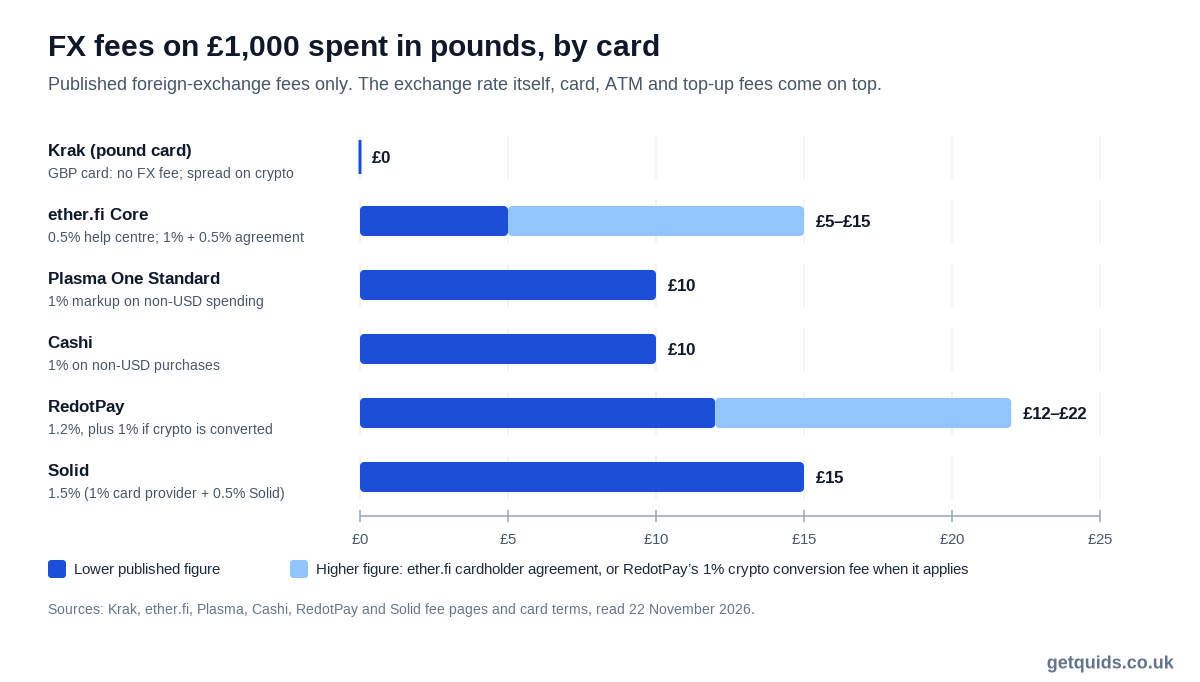
| Krak | Virtual and plastic free; metal free with a 30-day average balance of £50,000 or more | No FX fee (pound card); a spread applies when crypto or another currency is sold to pay | Faster Payments in pounds, free, £2 minimum; debit card £0.25 + 3.75%; PayPal with fees shown before you confirm | No Krak fee; the machine's operator may charge |
| ether.fi Cash (Core) | One virtual card ($10 in some regions); physical card $50 | 0.5% on Core for currencies other than USD and EUR (help centre); the cardholder agreement also lists a base 1% foreign transaction fee | Pounds by Faster Payments, with fees shown before you confirm | 10 free withdrawals a month on Core |
| Plasma One Standard | $0 a year; virtual card only | 1% markup on spending in currencies other than USD | No pound route listed on its comparison page; account services run through Bridge | Not listed |
| Cashi | $5 activation, returned straight away as $5 spending credit | 1% on purchases in currencies other than USD | Digital assets (no Cashi fee; the network charges its own); cash deposits with a fee shown in the app | Not listed |
| RedotPay | Virtual $10; physical $100 | 1.2% in a currency other than the card's, plus 1% if crypto has to be converted | Paid from your RedotPay crypto balance | 2% on Hong Kong dollar cards; US dollar cards 2% up to $10,000 a month, then 3% |
| Solid | Free; optional Prime rewards plan at $199 a year | 1.5% on spending in currencies other than USD (1% card provider, 0.5% Solid) | Crypto deposits ($10 minimum; free on Fuse, 0.03% to 0.1% elsewhere); bank deposits 0.5% on Core; no pound route named | Not listed on its fee page |
Fees as published on 22 November 2026; the providers' live fee pages and in-app quotes prevail. The FX fee sits on top of the exchange rate the card network or provider uses. Pulsar Money is left out because it publishes no fixed card fees.
The FCA position: who is regulated for what
Being on the FCA register as a crypto firm is not the same as being authorised like a bank. A firm on the register as a cryptoasset business is registered under the Money Laundering Regulations, and the register says just that: for these firms it only shows anti-money-laundering registration, and neither the Financial Ombudsman Service nor the FSCS can consider a complaint or claim about them. Payward Ltd, Kraken's UK company, is in that position.
The card itself often comes from a separate e-money firm. Monavate Ltd (Krak's issuer) and Stripe Payments UK Ltd (named in Plasma's terms) are authorised e-money institutions. Monavate's register entry, for example, says the Ombudsman may be able to consider a complaint, the FSCS will not compensate you if the firm fails, and the firm may have to safeguard customer funds. Safeguarding covers money that firm holds, not crypto in a separate wallet or app.
Change is coming. The FCA opened applications for its new crypto authorisation regime on 30 September 2026, asks firms to apply by 28 February 2027, and the regime comes into force on 25 October 2027. Authorisation is not automatic: firms that want to keep operating in the UK must apply and show they meet the FCA's standards. For a plain comparison of FSCS deposit protection and e-money safeguarding, see our UK money guide for international students.
FCA register check, 22 November 2026
| Firm searched | Its role here | What the register shows |
|---|---|---|
| Monavate Ltd | Issues the Krak card in the UK | Authorised e-money institution since 4 November 2020, FRN 901097 |
| Payward Ltd | Kraken's UK crypto company | Registered cryptoasset firm under the Money Laundering Regulations since 23 November 2021, FRN 928768; no Ombudsman or FSCS cover |
| Stripe Payments UK Ltd | UK card issuer named in Plasma's terms | Authorised e-money institution since 2 May 2018, FRN 900461 |
| ether.fi; Third National | ether.fi app; ether.fi card issuer | No results for either name |
| Fuse Network Ltd | Operates Solid | No results |
| RedotPay; Red Dot Technology | RedotPay app and its Hong Kong company | No results for either name |
| Pulsar Money | Pulsar app | No results |
| Plasma | Plasma One app | Plasma's UK notice says it is not an FCA-regulated firm, so the Ombudsman cannot consider a complaint about it |
Search the FCA register yourself for the app's company and for the card issuer named in your card terms; names change, and an unauthorised firm can also appear there with a warning.
Tax: when a card payment becomes a disposal
HMRC's Cryptoassets Manual gives four examples of a disposal: selling tokens for money, swapping them for another token, using them to pay for goods or services, and giving them away (except to a spouse or civil partner). A card payment funded by tokens is the third one, valued in pounds on the day.
The gain or loss is that sterling value minus the tokens' share of your pooled cost. Tokens bought on the same day, or in the 30 days after the disposal, are matched first under the share rules; everything else comes from the pool. Transaction fees can count as allowable costs.
Dollar stablecoins are not exempt: HMRC classes stablecoins as cryptoassets. They aim to hold a dollar price, and the pound moves against the dollar, so spending them produces small gains or losses. The FCA's own example: measured in pounds, Tether fell 24.75% from its July 2018 peak to 1 December 2025.
Your gains for the tax year are added together. The first £3,000 is tax-free (the annual exempt amount); above that, gains are taxed at 18% where they fall in the basic-rate band and 24% above it. If your total gains are over the allowance you must report them, through Self Assessment (which has a cryptoasset section from the 2024 to 2025 return) or HMRC's real-time Capital Gains Tax service. Exchange reports help but don't track pooled costs, so keep your own log.
Since 1 January 2026, crypto service providers have had to collect your name, date of birth, address and tax number (for a UK resident, your National Insurance number or UTR). Missing or wrong details given to a UK provider can bring a penalty of up to £300. Cashback paid in a token is a token you hold: selling, swapping or spending it later is a disposal too.
Worked example: two card payments of about £300, two tax results
| Step | Paid from a dollar stablecoin | Paid from another crypto token |
|---|---|---|
| What you hold | 1,250 USDC bought for £1,000 (assumed £1 = $1.25) | 100 tokens bought for £2,000 in total (pooled cost £20 each) |
| The payment | A bill that uses 400 USDC, worth £330 on the day because the pound has weakened | A £300 bill; the app sells 10 tokens worth £30 each |
| Allowable cost from the pool | 400 ÷ 1,250 × £1,000 = £320 | 10 × £20 = £200 |
| Gain added to the year's total | £10 | £100 |
| What would change it | A stronger pound on the day turns the same payment into a loss | The token's sterling value that day; tokens bought the same day or in the next 30 days are matched first |
Illustrative numbers, not market prices or a forecast. Card and FX fees are left out; HMRC lets transaction fees count as allowable costs. With no other gains in the tax year, the first £3,000 of gains like these is covered by the annual exempt amount; gains above it are taxed at 18% or 24%.
Before you apply: checks in order
- Read the provider's current country page for a UK address. If it only publishes exclusions, expect the app to decide at the identity check.
- Search the FCA register for the app's company and for the card issuer named in the card terms. Note whether each is an authorised e-money firm, a registered crypto firm, or not there at all.
- Find the card's currency. On a dollar card every UK purchase pays the FX fee; on Krak's pound card, set the spend order so pounds go first if that's what you want.
- Decide what will fund the card. Pounds held in the app don't create a disposal; stablecoins and other tokens do.
- Price the whole thing: card fee, top-up fee, FX fee, cash-machine fee and any membership plan, against how much you would actually spend.
- Check the exit: how you move money back to a UK bank account (ether.fi and Krak both send pounds out by Faster Payments) and what happens to your balance if the card programme closes, as Solid's Rain cards did on 20 November 2026.
- Log every crypto-funded payment from day one: date, token, amount, sterling value and fees. You will need the log for Capital Gains Tax.
Who might use one, and who should skip it
A crypto card can make sense if you already hold stablecoins or crypto, want to spend some of it without first moving it to a bank, accept the tax bookkeeping, and pick a card whose currency matches your spending. For everyday spending in pounds, that points to a pound card or to accepting a 0.5% to 1.5% FX fee on every purchase.
Skip it if you want protection for the money on the card: the FSCS does not cover crypto, and several of these firms are outside the Ombudsman's reach. Skip it if the attraction is cashback paid in a token, because that adds crypto exposure rather than cash. And skip it if you don't want to track disposals; for ordinary spending in pounds, a UK bank or e-money account does the same job without the FX fee or the tax paperwork.
FAQ
- Can I get a crypto debit card if I live in the UK?
- Some cards accept a UK address. On their own country pages, ether.fi, Solid, Krak and Pulsar Money name the UK; Plasma One, RedotPay, Cashi and Infini don't exclude it. Approval still depends on each provider's identity checks.
- Is paying with a crypto card taxable in the UK?
- It can be. HMRC treats using tokens to pay for goods or services as a disposal, so each crypto-funded payment can create a gain or loss. Gains for the tax year are added together; the first £3,000 is tax-free, and gains above that are taxed at 18% or 24%.
- Does spending a stablecoin like USDC create a gain?
- It can, usually a small one. A dollar stablecoin's value in pounds moves with the exchange rate, so the sterling value when you spend it rarely matches what you paid. A stronger pound gives a loss, a weaker one a gain.
- Are crypto cards covered by the FSCS?
- No. The FCA says you should not expect FSCS compensation for crypto. Where the card issuer is an FCA-authorised e-money firm, it may have to safeguard the money it holds, but that is not FSCS cover and does not extend to crypto in the app.
- How do I check whether a crypto card provider is regulated in the UK?
- Search the FCA register for both the app's company and the card issuer named in your card terms. A registered cryptoasset firm is registered only under the Money Laundering Regulations, with no Ombudsman or FSCS cover; an authorised e-money institution is regulated for the payments side.
- Why do I pay an FX fee when I spend in the UK?
- Most crypto cards run in US dollars, so a purchase in pounds is converted and the provider adds its fee: 0.5% to 1.5% on the cards compared here. Krak's UK card runs in pounds and charges no FX fee, though it sells crypto at a spread if crypto pays.
- Can I top up a crypto card with pounds?
- Krak and ether.fi accept pounds by Faster Payments; Krak's is free with a £2 minimum. Solid, Plasma One and RedotPay name no pound bank route on their own pages, so a UK reader funds them in crypto or another currency.
- Why doesn't GetQuids show referral codes for crypto cards?
- The FCA's rules for marketing cryptoassets to UK consumers ban refer-a-friend bonuses and similar incentives, so this guide compares the cards without codes or sign-up links.