Octopus Energy referral code: how the switch and credit work
By GetQuids· Last verified: 22 November 2026 (HKT)· 13 min read
How the Octopus Energy referral credit is paid, how long a switch takes, what Flexible, fixed, Tracker, Agile and Intelligent Octopus Go cost against Ofgem's price cap, and who can switch when renting.
Ad / referral links — we may earn a bonus when you sign up.
The referral credit: what you get and when it lands
Octopus pays referral credit to a new customer who signs up through an existing customer's personal link. Through our link you get £50 energy credit on your energy account for a home switch. It reduces what you owe Octopus; it isn't paid out as cash. Octopus publishes no end date for the scheme, and its terms let it change or cancel promotions without notice.
The credit is added automatically once your supply has fully switched over and your first monthly Direct Debit has been taken. Octopus says that typically takes about four weeks from joining, or longer if your old supplier delays the switch. In the app it appears in the Bills tab as a REFERRAL REWARD line; on the website it's under Payments, then View My Balance History.
Prepayment meters qualify too, as long as you sign up directly through the link. With a key or card meter, ask Octopus for the credit once your account is set up: either as a refund to your bank account, which you can then use to top up, or as a key or card preloaded with it. With a smart prepayment meter, ask Octopus to add it to the meter. For service, app ratings and complaints, read our Octopus Energy review.
Referral credit: every condition, checked 22 November 2026
| Condition | What Octopus's terms say | What to do |
|---|---|---|
| How you join | Only sign-ups made directly online through a personal referral link qualify. Referrals claimed after the event are not rewarded | Open our link (code ) before you start the quote, and finish the sign-up from there |
| Comparison sites | Joining through a price comparison site or another third party earns no referral credit | Get the quote on Octopus's own site through the link |
| New customer | No credit if you have been an Octopus customer in the last 12 months, or if you or the property are already supplied by Octopus, one of its white-label brands or under the Bulb licence | If you left Octopus, wait until 12 months have passed since you were last a customer |
| Supply and first payment | Paid once you are supplied by Octopus and your first successful Direct Debit is taken. Cancelling before supply starts or before that payment means no credit | Keep the Direct Debit in place until the credit shows on your account |
| Moving house | An existing customer who moves home gets no second referral credit | Tell Octopus you're moving; it can supply the new home under a new contract |
| More than one offer | If you qualify for several marketing incentives, Octopus may give you only one: the highest-value one | Don't count on stacking the referral credit with another Octopus sign-up promotion |
| Business or charity | Business and charity accounts have their own referral amount | See our Octopus offer page for the current figure |
The reward amount comes from our live offer card. Octopus's domestic terms (version 3.10, 20 October 2026) and its referral help pages set the final rules.
Switch through our Octopus link

Provider
Octopus Energy
Thinking of switching energy supplier? Move to Octopus Energy with referral code teal-eve-757 and you get £50 energy credit on a home switch. Business and charity switches get a fatter £75. The credit usually lands after your switch completes and the first Direct Debit goes through — it's account credit, not instant cash. One sensible rule: compare the tariff against your current deal first. Only switch if the numbers work for your usage, not just for the fifty quid.
Requirement: Eligible Octopus Energy home, business, or charity switch
Medium10-15 minutesPayout Typically about four weeks after joining, once your switch completes and the first monthly Direct Debit is taken
Verified 22 November 2026
How switching works, and how long it takes
Octopus says signing up takes no more than five minutes, and the quote is four quick questions, three of them multiple choice. Have a recent bill to hand: Ofgem says a new supplier needs your postcode, the names of your current supplier and tariff, your unit rates and your yearly kWh. If you can't find your yearly use, Ofgem's typical figures are 2,500 kWh of electricity and 9,500 kWh of gas.
After you sign up, Octopus tells your old supplier for you. It usually switches you within 3 working days, unless you ask for a later start date. Ofgem requires every switch to finish within 5 working days; if it doesn't, the new supplier must pay you £40, automatically, into your energy or bank account.
You can still change your mind. Octopus's terms give you 14 days from the day you apply to cancel by email or online, with no exit fee; you pay only for energy used after supply started. Octopus may run credit and fraud checks when you join, and its terms say it typically asks for a deposit or payment in advance before connecting your supply, with the amount based on your credit history. There's no security deposit on a traditional prepayment meter or a smart meter in prepayment mode.
Switching timeline: what happens and when
| Stage | When | What happens |
|---|---|---|
| Quote and sign-up | Day 0, about 5 minutes | Start from our link, answer four questions and accept the terms. Octopus contacts your old supplier |
| Cooling-off | 14 days from the day you apply | Cancel by email or online with no exit fee; you pay only for energy used after supply starts |
| Supply starts | Usually within 3 working days; 5 working days at most | Miss 5 working days and the new supplier pays you £40 automatically. You can ask Octopus for a later start date |
| Switch day | On the day | Take meter readings so you aren't charged for energy used before the switch. A smart meter working in smart mode sends them for you |
| Old supplier's final bill | Within 6 weeks | Any credit left on the old account is refunded within 10 working days of the final bill |
| First Direct Debit | Monthly, with at least 5 working days' notice | Set at Octopus's estimate of your yearly use divided by 12, plus your balance, and reviewed at least twice a year |
| Referral credit | Typically about 4 weeks after joining | Added automatically after supply starts and the first monthly Direct Debit is taken |
| Smart tariffs (optional) | After the switch; connecting to your smart meter takes around 14 days | Move from Flexible to Agile, Tracker or Intelligent Octopus Go once Octopus receives half-hourly readings |
From Octopus's switching help pages and terms, Ofgem's switching rules and Citizens Advice, read 22 November 2026.
The Energy Price Cap, in plain numbers
Ofgem's price cap sets the most a supplier can charge per kWh, and per day in standing charges, on a standard variable tariff such as Flexible Octopus. It doesn't cap your total bill: use more and you pay more. Fixed tariffs, business contracts, heat networks and heating oil sit outside it. Ofgem resets the cap every three months, and the rates vary by region, payment method and meter.
From 1 October to 31 December 2026 the average Direct Debit rates across England, Scotland and Wales are 26.32p per kWh of electricity with a 54.83p daily standing charge, and 7.97p per kWh of gas with 29.68p a day. Ofgem turns that into £1,723 a year for a typical home, measured since 1 July 2026 at 2,500 kWh of electricity and 9,500 kWh of gas (it used 2,700 and 11,500 kWh before). There's no VAT on electricity from 1 October 2026 to 31 March 2027; gas still carries 5%.
Octopus publishes Flexible prices for each of its 14 regions. On 22 November 2026 its electricity unit rates averaged the same 26.32p as the cap and its gas unit rates the same 7.97p; the standing charges averaged a little lower, at 53.76p and 28.72p a day. That small gap is the whole difference between Flexible and the cap at typical use.
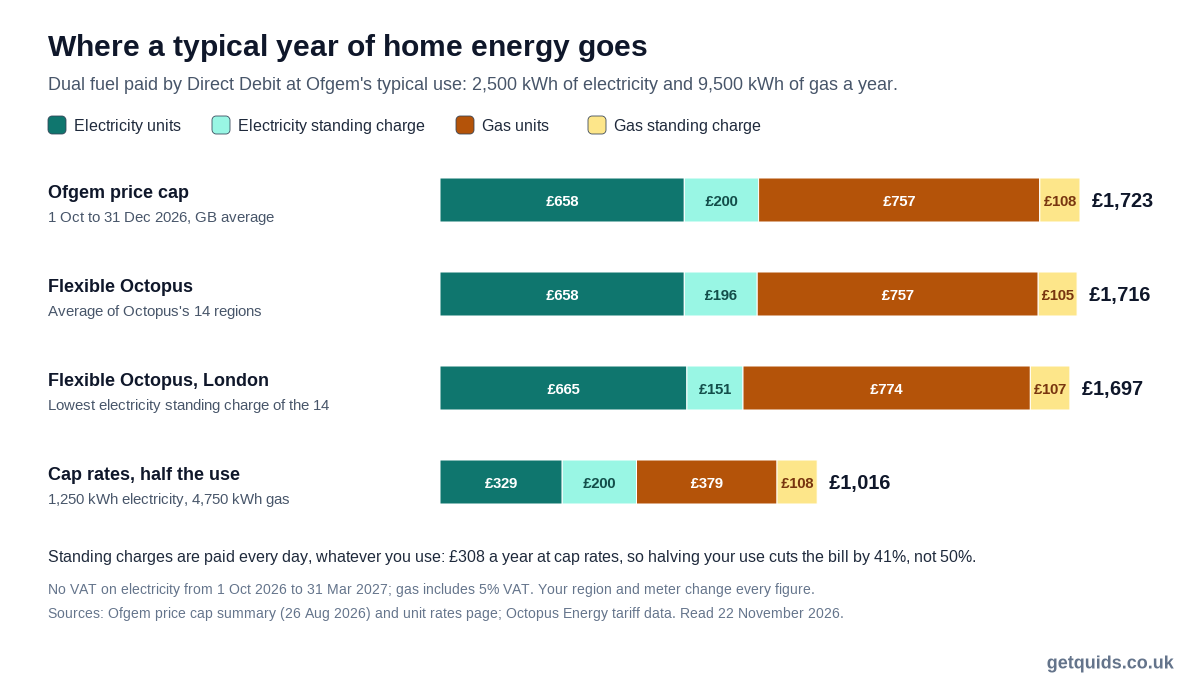
Worked example: a year of energy at Ofgem's typical use
| Line | Price cap (GB average) | Flexible Octopus (14-region average) | Flexible Octopus, London |
|---|---|---|---|
| Electricity: 2,500 kWh | £658.00 (26.32p/kWh) | £658.06 (26.32p/kWh average) | £664.89 (26.60p/kWh) |
| Electricity standing charge: 365 days | £200.13 (54.83p a day) | £196.24 (53.76p a day average) | £151.06 (41.39p a day) |
| Gas: 9,500 kWh | £757.15 (7.97p/kWh) | £756.81 (7.97p/kWh average) | £773.89 (8.15p/kWh) |
| Gas standing charge: 365 days | £108.33 (29.68p a day) | £104.84 (28.72p a day average) | £106.73 (29.24p a day) |
| Year | £1,723.61 (Ofgem quotes £1,723) | £1,715.95 | £1,696.57 |
| Per month, spread evenly | £143.63 | £143.00 | £141.38 |
Assumptions: dual fuel, a single-rate electricity meter, payment by Direct Debit, a 365-day year and Ofgem's 2026 typical use. Flexible Octopus rates include VAT on gas and were read from Octopus's tariff data on 22 November 2026; London is Octopus's London region. Your quote uses your own postcode and usage, and Octopus sets your Direct Debit from its estimate of your year, not an even split of these figures.
Octopus's main home tariffs compared, 22 November 2026
| Tariff | How the price works | What it costs now | Exit fee and switching rules | What you need |
|---|---|---|---|---|
| Flexible Octopus | Variable: prices move with the cost of supply and usually change every 3 months. Covered by Ofgem's cap | £1,716 a year at typical use, averaged across 14 regions (£1,664 in the East Midlands to £1,799 in Merseyside and North Wales) | None | Nothing extra: new customers join on Flexible |
| Octopus 12M Fixed | Unit rates and standing charges fixed for 12 months | £1,939 a year averaged across 14 regions (£1,877 to £2,037) | £50 per fuel; none in the final 49 days | Nothing extra |
| Octopus 18M Fixed | Unit rates and standing charges fixed for 18 months | £1,888 a year averaged across 14 regions (£1,827 to £1,983) | £75 per fuel; none in the final 49 days | Nothing extra |
| Octopus Tracker | Electricity and gas prices change daily from a published wholesale formula, capped at 100p/kWh for electricity and 30p/kWh for gas. Octopus says prices typically rise in colder months, likely doubling | Changes every day; new customers can't join it directly | No exit fee. Leave during the 12-month term and you can't rejoin for 9 months, unless you leave in its last 49 days | An Octopus account (join Flexible first) and a compatible smart meter: SMETS2, or a SMETS1 with a Secure logo |
| Agile Octopus (electricity) | Half-hourly prices tied to wholesale prices, published daily between 4pm and 8pm for the next 24 hours, capped at 100p/kWh. Prices can drop below zero | London, 15 to 21 November 2026: 24.24p to 61.26p per kWh, a simple average of 35.64p; 4pm to 7pm averaged 54.36p | No exit fee. After leaving a smart tariff you can't join one again for 30 days | A smart meter sending half-hourly readings; join Flexible first |
| Intelligent Octopus Go (electricity) | A cheap rate for the whole home from 23:30 to 05:30, plus up to 6 hours a day of managed car charging at that rate | Variable: 9.90p/kWh overnight, 32.53p to 36.31p by day. Go Max: 6.50p overnight, 36.44p to 40.72p by day. 12M Fixed: 7.90p overnight | Variable versions: none. 12M Fixed: £50 | A compatible electric car or charger registered in the app within 7 days, and a smart meter; join Flexible first |
Annual costs are for a dual-fuel home on a single-rate meter at 2,500 kWh of electricity and 9,500 kWh of gas, paid by Direct Debit. Exit fees are per fuel, so leaving a dual-fuel 12M Fixed early costs £100. Agile and Intelligent Octopus Go cover electricity only, so gas stays on another tariff. Rates from Octopus's tariff data, read 22 November 2026.
Fixed, Flexible or smart: reading this winter's numbers
At today's prices a fix costs more than Flexible. The 12-month fix averages £223 a year more than Flexible's £1,716, so Flexible prices would need to average about 13% above today's over the next 12 months for the fix to come out cheaper. The 18-month fix averages £172 a year more, a break-even of about 10% above today's prices across 18 months. Octopus's January forecast sits above both fixes, but it covers three months, and Octopus says nobody knows what happens after April.
So the choice is certainty against freedom to leave, not a sure saving. A fix suits you if a predictable bill matters more than the price and you're happy to stay: leaving early costs £50 or £75 per fuel, except in the final 49 days. Flexible suits you if you want to be able to go at any time without a fee; Octopus says it has priced Flexible below Ofgem's cap every day since the tariff began.
Agile and Tracker follow wholesale prices, which makes them cheaper in some periods and dearer in others. In London from 15 to 21 November 2026, only 19 of Agile's 336 half-hourly prices were below Flexible's 26.60p, and the 4pm to 7pm peak averaged 54.36p. Octopus itself says customers on these wholesale-linked tariffs may pay more than standard-tariff customers in the short term. Leave Tracker part-way through its 12-month term and you can't rejoin for 9 months.
Intelligent Octopus Go works differently. With a compatible electric car or charger, its 9.90p overnight rate covers the whole home from 23:30 to 05:30, but its day rates sit well above Flexible's (34.16p against 26.60p in London). It pays off when a large share of your electricity, usually car charging, moves into the cheap hours.
Smart meters, Octoplus and Saving Sessions
You don't need a smart meter for Flexible Octopus or the fixes. You do for Agile, Tracker, Intelligent Octopus Go, Octoplus and Saving Sessions. Ofgem says you can get one from your supplier for free; Octopus customers book an installation in their online account, or join a waiting list where Octopus isn't installing yet. After installation it can take up to 14 days for Octopus to connect to the meter, and until then it can't take automatic readings. Already have a smart meter? Citizens Advice suggests checking it will keep working in smart mode after you switch. If you rent and the bill is in your name, getting one is your choice; Smart Energy GB recommends telling your landlord first, and if your tenancy says you need permission to change the meter, the landlord shouldn't unreasonably refuse.
Octoplus is Octopus's free rewards scheme for customers whose electricity comes from Octopus, who pay by Direct Debit and whose electricity smart meter sends half-hourly readings. You earn Octopoints: 800 are worth £1, they last three years, and you can turn them into bill credit, give them to charity or spend them at double value in Octopus's Shoptopus shop. Octopus says a referred customer gets 500 Octopoints on joining Octoplus.
Saving Sessions sit inside Octoplus. In a Power Down you earn Octopoints for each kWh you save against your usual use at a busy time; in a Power Up you earn them for the extra electricity you use when renewable supply is high, between 11am and 4pm, with the go-ahead around 10am that day. You opt in to each session, notice can be short, and points arrive within a few weeks. Octopus hasn't published dates or a points-per-kWh rate for winter 2026 to 2027, so treat them as a bonus rather than part of the bill maths.
Renters, flatshares and bills-included homes: who can switch
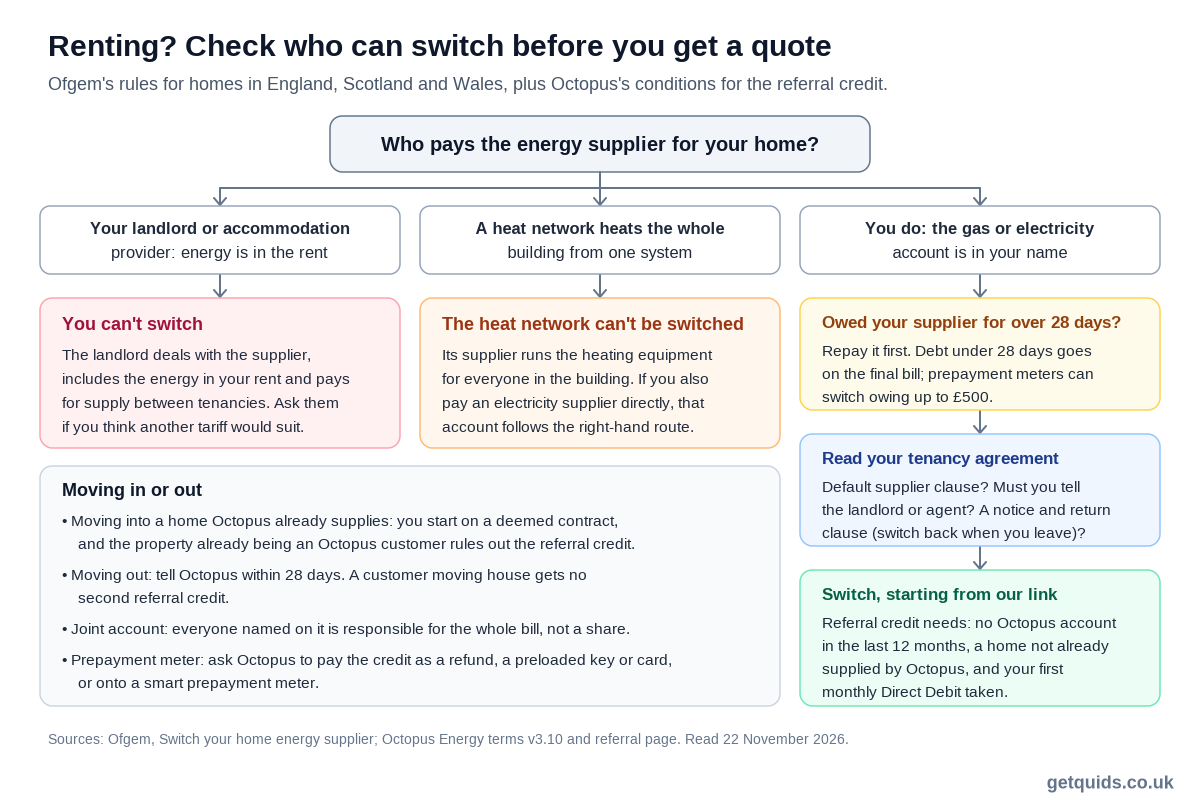
Ofgem's rule is simple: if you pay a supplier directly for the gas or electricity you use at home, you can switch supplier or tariff at any time, including as a tenant. Before you do, read your tenancy agreement for a default supplier clause (a list of suppliers you must choose from) and whether that list can be changed, whether you must tell the landlord or letting agent, and a notice and return clause, which means switching back to the original supplier when you leave.
If your landlord pays, you can't switch. Ofgem says the landlord should include the energy you use in your rent, deal with the supplier and pay for supply between tenancies, and Citizens Advice adds that if you pay your landlord for energy, you'll have to ask them to switch. That covers bills-included flatshares and halls of residence where the accommodation provider holds the account. A heat network that heats the whole building can't be switched either. Students leaving halls can use our international students' money guide for the order to set up the rest, and newcomers can check which UK sign-up offers they can claim.
In a flatshare, one or more of you can hold the account. Octopus's terms make everyone named on it jointly and severally liable, so each person can be chased for the whole bill, not just a share. The referral credit lands on that one account, so agree between you how it's shared.
Moving in? If the home is already supplied by Octopus, you start on its deemed contract and the referral credit doesn't apply, because the property is already an Octopus customer. If it's with another supplier and the account will be in your name, you can choose a new supplier once you've moved in and switch through our link. Moving out? Octopus's terms ask you to tell it within 28 days.
Exit fees: when leaving costs money, and when it doesn't
| Situation | Exit fee? |
|---|---|
| Leaving your current supplier's fixed deal with 49 days or less to run | No. Citizens Advice says you can switch without an exit fee in the final 49 days |
| Leaving a fixed deal with 50 days or more to run | Possibly: check your contract. Citizens Advice notes switching can still save more than the fee |
| Cancelling your switch to Octopus within 14 days | No; you pay only for energy used |
| Leaving Flexible Octopus, Agile or Tracker | No. Tracker has a 9-month wait to rejoin if you leave mid-term; any smart tariff has a 30-day wait |
| Leaving Octopus 12M or 18M Fixed early | £50 or £75 per fuel; nothing in the final 49 days of the contract |
| Leaving Intelligent Octopus Go 12M Fixed early | £50; nothing in the final 49 days of the contract |
| Octopus changes your contract to your disadvantage | No: you can leave or start a new contract without penalty (this doesn't apply when a fixed tariff simply ends) |
When an Octopus fix ends and you pick nothing, Octopus moves you to its cheapest variable tariff, a fix no dearer than that, or a comparable variable tariff. You can't switch supplier while you have owed your current supplier money for more than 28 days; prepayment customers can switch owing up to £500.
FAQ
- Is there an Octopus Energy referral code, or just a link?
- Both lead to the same referral: our code is , and our link carries it for you. Start the quote from the link and sign up on Octopus's own site. Octopus's terms say referrals claimed after sign-up, or made through a comparison site, aren't rewarded.
- When does the Octopus referral credit arrive?
- After your supply has switched over and your first monthly Direct Debit has been taken. Octopus adds it automatically and says that typically takes about four weeks from joining, longer if your old supplier delays the switch. The amount is on our Octopus offer page.
- How long does it take to switch to Octopus Energy?
- Octopus usually switches you within 3 working days of signing up. Ofgem's limit is 5 working days; miss it and the new supplier pays you £40 automatically. You have 14 days from applying to cancel without an exit fee.
- Is Flexible Octopus cheaper than the price cap?
- Only slightly. On 22 November 2026 a typical dual-fuel home on Flexible paid £1,716 a year averaged across Octopus's 14 regions, against the £1,723 cap. The unit rates averaged the same as the cap; the standing charges were a little lower. Your region changes the figure.
- Can I switch to Octopus if I rent?
- Yes, if you pay the supplier directly and the account is in your name. Check your tenancy for a default supplier clause, whether you must tell the landlord, and a notice and return clause. If your landlord pays and the energy is in your rent, only the landlord can switch.
- Do I need a smart meter to switch to Octopus?
- No. Flexible Octopus and the fixed tariffs work with an ordinary meter. You need a smart meter for Agile, Tracker, Intelligent Octopus Go, Octoplus and Saving Sessions, and Ofgem says you can get one from your supplier for free.
- Will I pay an exit fee to leave my current supplier?
- Only if you're on a fixed deal with 50 days or more to run, and then only if the contract has one. In the final 49 days you can switch without an exit fee, and Flexible Octopus has no exit fee at all.
- I was with Octopus before. Can I still get the credit?
- Only if you haven't been an Octopus customer in the last 12 months. Moving into a home Octopus already supplies doesn't qualify either, and an existing customer moving house gets no second referral credit.