
Honeygain Review (UK): Is Renting Out Your Spare Broadband Worth a Few Dollars a Month?
Honeygain reviewed for UK readers: what sharing your connection really involves, realistic earnings, the US$20 PayPal payout and its US$2.02 fee, Content Delivery, broadband-contract and IP-reputation risks, and the US$3 invite credit.
Last updated 14 November 2026

Honeygain
Ad / referral links — we may earn a bonus when you sign up.
Full details & steps →Best for
People in the UK with an always-on Windows or Mac computer on unlimited home broadband whose contract allows sharing, who are comfortable with business traffic leaving through their IP address for a few dollars a month.
Honeygain does pay, just slowly. After the US$3 (about £2.30) invite credit you still need 17,000 credits for the US$20 PayPal minimum: roughly four months for a computer holding a Content Delivery slot, and most of a year on ordinary sharing alone. The real price isn't money but your IP address, which carries strangers' business traffic, so read your broadband terms first and skip it if you rely on a clean connection for work, banking or streaming.
Pros
- US$3 (about £2.30) at sign-up through our invite, 15% of the way to the first payout
- Fully passive once installed: no surveys, tasks or adverts
- Content Delivery pays a fixed 6 credits an hour in the UK on a Windows or Mac computer
- PayPal payouts land 2 to 3 business days after Tipalti sign-up, for one flat US$2.02 fee
- Runs on Windows, macOS, Android and Linux, so an old laptop or spare Android phone can do the work
Watch-outs
- Small, unpredictable earnings: no published rate, roughly US$0.10 per GB by a June 2026 estimate, often a few dollars a month per device
- Business traffic exits through your home IP, with more CAPTCHAs, possible blocklisting and the odd blocked site as side effects
- Security researchers class this kind of app as riskware, and a 2026 investigation saw traffic tied to a US-sanctioned bank pass through its test connection
- US$2.02 off every payout, plus a conversion fee if you take pounds
- Your broadband terms may forbid it, and mobile data costs can wipe out the gains
- Trustpilot hides its rating after removing fake reviews, and support was taking 4 to 5 business days
Current related offer
Honeygain offer pageAd / referral links — we may earn a bonus when you sign up.
Provider
Honeygain
Join Honeygain through our link and a US$3 credit (about £2.30) lands in your balance. The rest comes from letting the app sell your spare broadband to business clients: think a few dollars a month per device, a US$20 minimum before PayPal, and a US$2.02 fee when you get there.
Requirement: Nothing to pay, but you need a computer or Android phone, a UK broadband contract that allows sharing, and patience: US$20 (about £15.60) in your balance, including the US$3, before you can cash out
EasyAbout 5 minutes to sign up and install; then it runs in the backgroundPayout The US$3 credit is added when you sign up through the invite. Cash-outs start at US$20; PayPal pays 2 to 3 business days after the one-off Tipalti sign-up
Verified 14 November 2026
Full claim instructions are on the Honeygain offer page.
What Honeygain is, and who's behind it
Honeygain is an app that pays you for letting businesses route web traffic through your internet connection. It's run by Honeygain, UAB, a Lithuanian company based in Vilnius that launched the app in 2019, and it now sits inside Source, a group that also owns the proxy and web-data businesses Oxylabs, Decodo, Webshare and ScrapingBee. Source describes Honeygain plainly: a network where people share bandwidth for rewards, which becomes a residential proxy pool.
That makes the trade simple to state. Proxy customers want their requests to look like they come from ordinary homes in particular countries, and your broadband is an ordinary home in the UK. Honeygain pays you in credits (1,000 credits = US$1) for the traffic it sends through you, and its homepage claims more than 60 million users and an average payout of US$27.
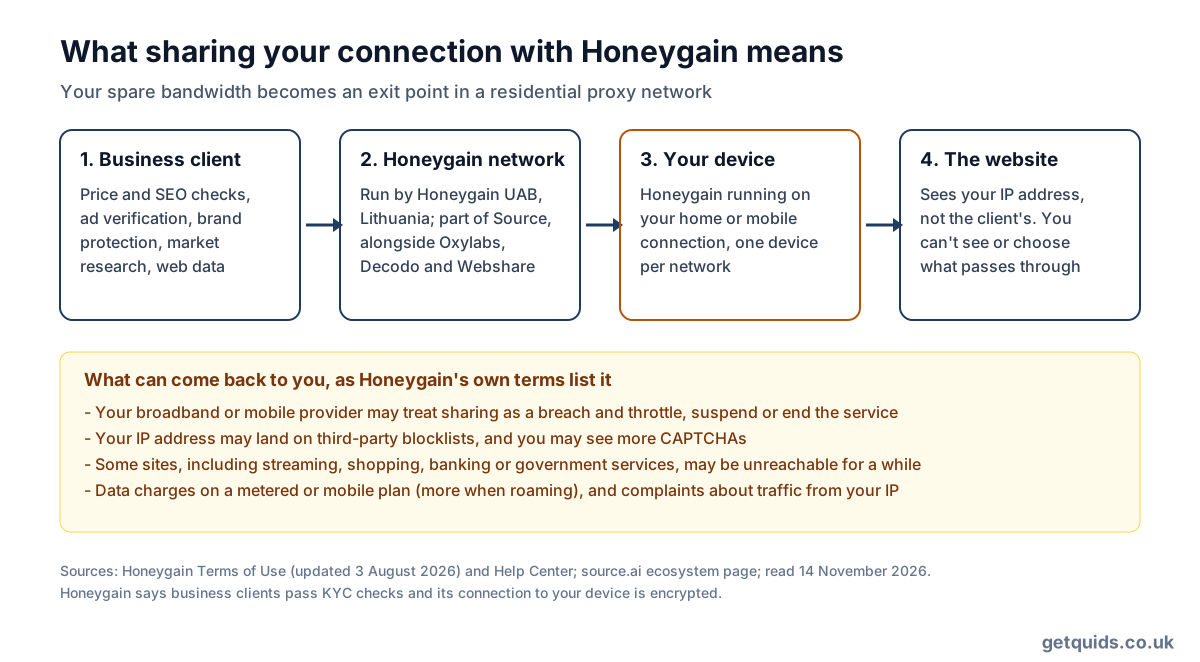
What sharing your connection actually means
Honeygain's terms name its clients as companies doing web and market analytics, SEO monitoring, brand protection, market research and cybersecurity, plus advert verification, collecting public web data and reaching streaming services. When they use your device, the website at the other end sees your home IP address, not theirs. Clients don't know whose connection they're using and you can't see or choose what passes through.
Honeygain says every client completes know-your-customer forms, that the link to your device is encrypted, and that it joined the anti-malware testing body AMTSO in 2025. None of that changes who the destination site thinks it's talking to: you. That is the core of the decision, more than the money.
The invite: US$3 to start, and what it's really worth
Sign up through our Honeygain link and Honeygain adds US$3 worth of credits (3,000 credits, about £2.30) to your new account. The link on this page is ours. The credit only goes to new accounts created through the invite, so someone already on Honeygain can't claim it, and a second account to collect it breaks the one-person-one-account rule.
Be clear about what the US$3 is: a head start, not cash. It counts towards the US$20 payout threshold and can't be withdrawn on its own, so it's worth something only if you go on to earn the other US$17. If you later switch to JumpTask mode, it stays behind in your Honeygain balance.
What you'll realistically earn in the UK
Honeygain publishes no fixed rate for ordinary sharing. It pays for traffic actually used, which depends on how much clients want UK traffic that week and how many other users are sharing it, not on your broadband speed or how much you use the internet. It also warns that new accounts often see more traffic in their first 1 to 2 weeks while it runs checks, so a strong first fortnight isn't the long-run rate. A June 2026 Digital Citizens Alliance investigation put earnings at roughly US$0.10 per GB shared, and the user quote Honeygain chooses for its own homepage says around US$20 every few months is realistic.
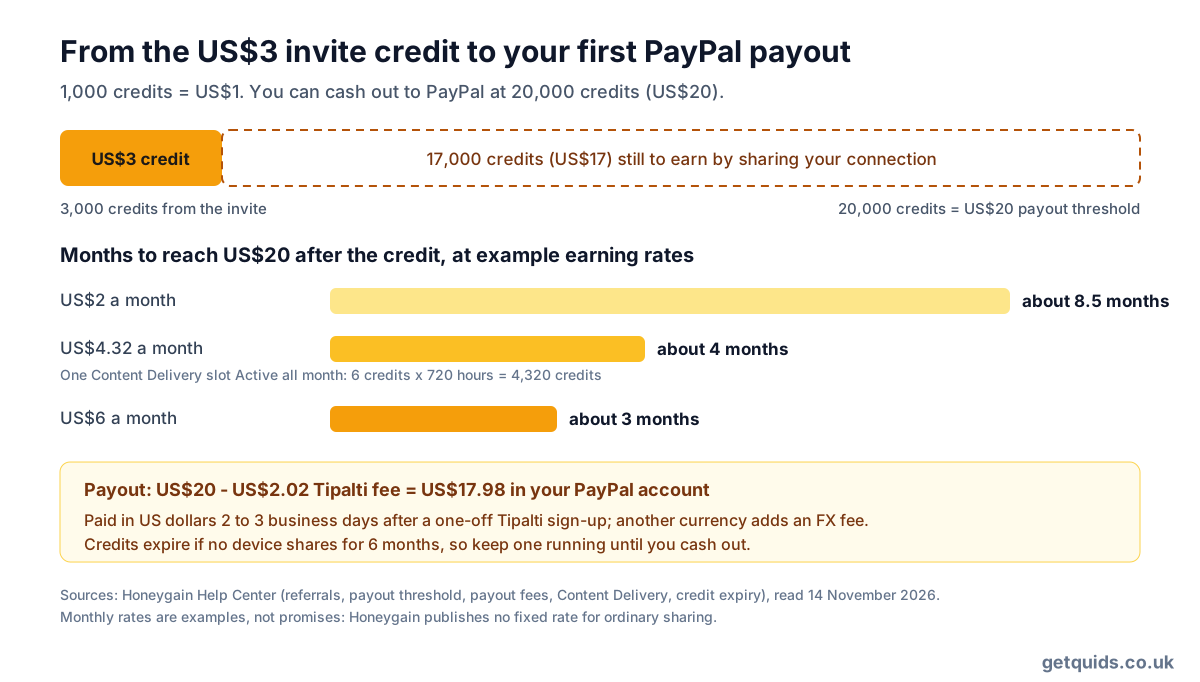
The one predictable stream is Content Delivery: 6 credits an hour while your Windows or Mac computer's status is Active, whatever the traffic. A computer that holds an Active slot for a whole 30-day month earns 4,320 credits, about US$4.32 (£3.40), plus Honeygain mode's 5% boost. The catch is the queue: only a limited number of devices can use it at once and there's no fixed wait. Add a few credits from the daily Lucky Pot and you get the shape of it: a few dollars a month per device, a little more if Content Delivery stays switched on.
Getting paid from the UK: PayPal, Tipalti and the US$2.02 fee
At US$20 (20,000 credits) you click Payout, choose PayPal and enter a code sent to your email. Payouts go through Tipalti, which emails an invitation within a business day; you register once with a password, a text-message code and your details exactly as they appear on your PayPal account. The money arrives 2 to 3 business days after registration, less a flat US$2.02 fee, so a US$20 payout leaves US$17.98, about £14. It's paid in US dollars; choosing pounds in Tipalti adds a conversion fee, and PayPal may convert or charge on arrival.
Two deadlines matter. A payout that isn't completed within 3 months, usually because the Tipalti sign-up was left half-done, may be written off under the terms, and claims about a wrong payout must reach Honeygain within 60 days. JumpTask mode is the alternative route: new earnings go to a separate JumpTask account and can be cashed out as gift cards from US$0.50, but you lose the 5% Honeygain-mode boost and the US$3 credit doesn't follow you there.
Devices, Content Delivery and the one-per-network rule
Honeygain runs on Windows 7 or newer, macOS 10.15 or newer, Android 5.0 or newer, and Linux through Docker. There's no iPhone or iPad app, and Google removed the Android app from Google Play under its Device and Network Abuse policy, so Android users install it from Honeygain's website, and only from there. You can link up to 10 devices, but only one per network earns: a laptop and a phone on the same home Wi-Fi count once, and the second shows "Network overused".
Content Delivery needs Windows or macOS, an ordinary ISP or mobile IP address, and one of 45 countries, which include the UK. It carries heavier content such as video and large websites, so your data use rises noticeably while it's on, and Honeygain admits that in rare cases Content Delivery users lose access to a streaming platform for a while because a client used their connection to reach it.
Your broadband contract, data caps and your IP's reputation
Every time the app runs, Honeygain's terms have you confirm that your broadband or mobile provider's terms don't prohibit sharing, that you hold the connection or have the account holder's permission, and that it isn't a work, university, library, hotel or other shared network. They then list what can follow: your provider may throttle, suspend or end your service; you may face data charges on a metered or mobile plan, more so when roaming; your IP may be added to third-party blocklists; you may see more CAPTCHAs; some sites, including streaming, shopping, banking or government services, may be unreachable for a while; and you may get complaints about traffic from your IP.
In practice that means three checks before installing: read your broadband provider's acceptable use terms, run it only on an unlimited home connection rather than a capped SIM, and ask whether you can live with a bank or streaming login occasionally asking for extra verification. If you share the connection with a household, the account holder needs to agree.
The security picture: what researchers found
In February 2023 Trend Micro classified bandwidth-sharing apps, Honeygain included, as riskware: not malware, but software whose risks users can't fully see. Through Honeygain's network it observed abuse of SMS phone-verification services, visits to possible click-fraud sites, probing for SQL injection weaknesses, attempts to read system password files and crawling of government websites.
In June 2026 the Digital Citizens Alliance and risk3sixty ran Honeygain on a test connection for several days and saw connections involving entities in China and Russia, including traffic tied to a bank sanctioned by the US Treasury. The report says it found no indication that Honeygain knew how those connections were used. Honeygain's answer is client vetting and encryption; neither lets you see or block what your IP is used for.
What users complain about
On 14 November 2026 Trustpilot showed no Honeygain rating: it says the rating is unavailable because of a breach of its guidelines and that it has removed a number of fake reviews, with 22,565 reviews left. The recent one- and two-star reviews keep returning to the same themes: earnings far smaller than expected, the payout fee and exchange rate eating into a first US$20, payouts delayed or accounts suspended around payout time, slow support and antivirus warnings about the app.
Support delays are real: in November 2026 Honeygain's help centre warned of 4 to 5 business days for a reply. Suspensions come from its automated anti-cheat system, which doesn't tell you the reason; you can appeal, but credits earned up to a suspension are removed.
Joining, the rules, and leaving cleanly
Use our link before creating the account, then install the app on devices you own and leave it running. The things that get accounts suspended are listed plainly: several apps on one IP, a VPN or proxy, selling or sharing the account, public Wi-Fi, data-centre connections, mobile tethering and extra accounts for bonuses. You must be 18 or over.
Credits expire if no device shares for 6 months, and once a balance passes US$20 it must be paid out within 24 months. To leave, cash out first if you're over US$20, then delete the account under Profile settings and confirm by email; the balance goes with it. Uninstall the app from each device as well.
Who should try it, and who should skip it
Worth a go if you already leave a Windows or Mac computer on, your home broadband is unlimited and its terms allow sharing, and a few dollars a month for no effort appeals. Turn on Content Delivery, keep one device per network and treat the US$3 as a head start towards the first US$20.
Skip it if you're on a capped or mobile-only connection, work from home on a connection your employer relies on, share a household line without the account holder's agreement, or would mind a bank, streaming service or website treating your IP with suspicion. And if you're after real money rather than pocket change, an hour on a matched-spend or bank-switch offer pays far more than a year of Honeygain.
FAQ
- Is Honeygain legit?
- It's a real company, Honeygain, UAB in Lithuania, part of the Source group with Oxylabs, and it does pay by PayPal at US$20. Legit doesn't mean harmless for your connection, though: it sells your IP's traffic capacity to business clients, which is why researchers class it as riskware.
- How much can I earn in the UK?
- Honeygain publishes no rate. A June 2026 investigation estimated about US$0.10 per GB shared, and a computer that holds a Content Delivery slot all month adds 4,320 credits, about US$4.32. Most people should expect a few dollars a month per device.
- How long to reach the US$20 payout?
- With the US$3 invite credit you need 17,000 more credits: about 8.5 months at US$2 a month, about 4 months at US$4.32 and about 3 at US$6.
- Does it work on an iPhone?
- No. Honeygain runs on Windows, macOS, Android (installed from its website, not Google Play) and Linux through Docker.
- Will it slow my broadband or eat my data?
- Honeygain says it uses spare bandwidth, but your data use does go up, noticeably so with Content Delivery. On unlimited broadband that rarely matters; on a capped or mobile plan it can cost more than you earn.
- Is it allowed on my broadband?
- That depends on your provider's terms, which you have to confirm each time the app runs. Honeygain warns that a provider can throttle, suspend or end your service if it objects, so check before installing.
- Can I use a VPN with it?
- No. VPNs and proxies are banned and lead to suspension; most use data-centre IPs that Honeygain doesn't accept. If one was on briefly by accident, turn it off straight away.