
Rail Crypto Card Review: Are Its 3.5%–4% Fees and No-ID Waitlist Worth Waiting For?
Researched assessment of Rail's upcoming virtual crypto cards: Premium vs First class pricing, 11-network top-ups, 32 excluded territories, unnamed issuer terms and 45-day dormancy rules.
Last updated 25 November 2026

Rail
Ad / referral links — we may earn a bonus when you sign up.
Full details & steps →Best for
Crypto holders outside Rail's excluded territories who specifically want a high-limit virtual card with Apple Pay and Google Pay without upfront ID verification, and accept custodial risk plus 3.5%–4% top-up fees.
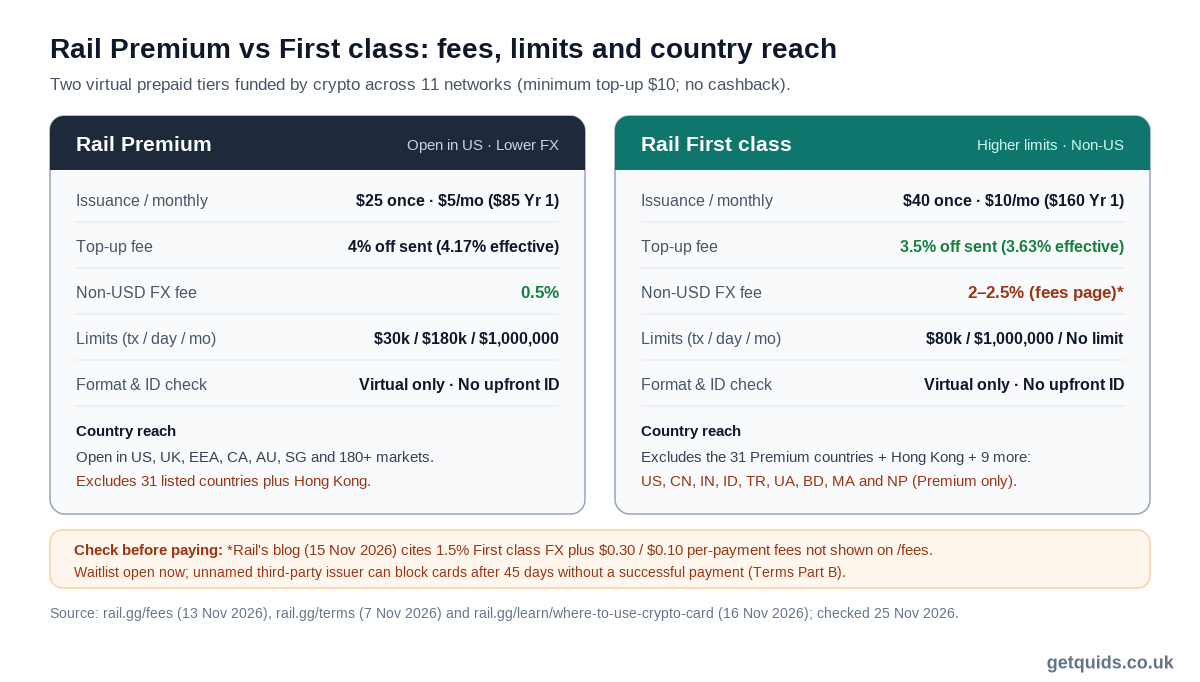
Rail is a pre-launch crypto card waitlist to judge on fees, limits and corporate transparency — not a sign-up bonus play. Our invite link puts you on the waitlist for free, with no published invitee cash bonus, fee waiver or card cashback. On paper, Rail targets a narrow gap: two virtual cards (Premium and First class) supporting Apple Pay and Google Pay, 8 crypto assets across 11 chains, limits up to US$80,000 per payment and US$1,000,000+ a month, and no upfront ID check. The trade-offs are heavy: US$85 or US$160 in Year-1 fixed fees, 3.5% or 4% taken off every top-up, zero cashback, conflicting fee figures between Rail's own pages, a 45-day inactivity block clause, and Terms of Use that name neither a corporate entity nor a licensed card issuer.
Pros
- Waitlist signup takes under a minute by email with zero deposit or identity documents required upfront
- Advertises no upfront ID check on either virtual tier while still supporting Apple Pay and Google Pay tap-to-pay
- Learn guides cover 8 crypto assets across 11 blockchains (USDC, USDT, USDG, ETH, BTC, SOL, POL and BNB) from a US$10 minimum top-up
- High spending ceilings: US$30,000 per payment and US$1,000,000/month on Premium, or US$80,000 per payment and no monthly cap on First class
- Premium opens to US residents and keeps non-USD foreign-currency fees at 0.5%
Watch-outs
- No welcome bonus, no issuance-fee waiver and 0% cashback on card spending
- Costly to fund and hold compared with KYC cards: US$25–US$40 issuance, US$5–US$10/month and 3.5%–4% deducted from every top-up
- Terms of Use and Privacy Policy never disclose a registered legal entity, address, card network, licensed card issuer or custodian, and carry no deposit insurance
- Rail's 15 November 2026 blog conflicts with rail.gg/fees on First class FX (1.5% vs 2–2.5%) and cites $0.30/$0.10 per-payment charges absent from the fee page
- Excludes 31 listed countries plus Hong Kong from both tiers, offers no physical card or ATM withdrawals yet, and permits permanent blocking after 45 idle days
- Pre-launch waitlist with no public App Store or Google Play listings and no verified live cardholder track record
Current related offer
Rail offer pageAd / referral links — we may earn a bonus when you sign up.
Provider
Rail
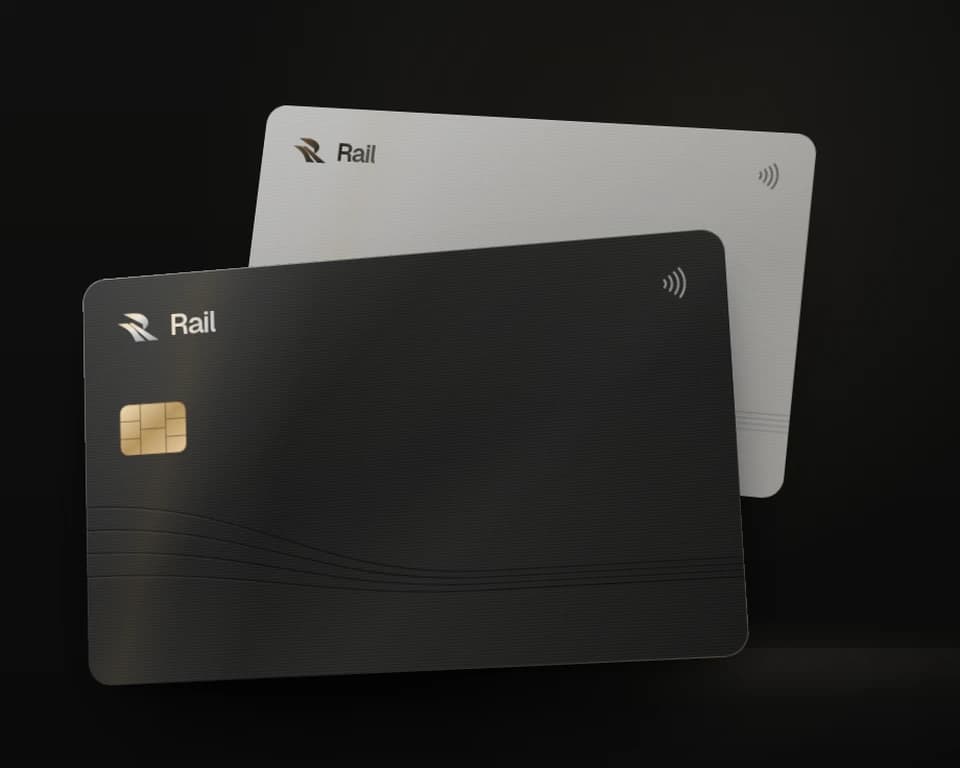
Register your email on the Rail waitlist through our invite link to hear when its two virtual crypto cards launch. Rail advertises no upfront ID check across 11 blockchains — Premium ($25 issuance, $5/mo, 4% top-up, 0.5% FX) and First class ($40, $10/mo, 3.5% top-up, 2–2.5% FX) — with no sign-up bonus or cashback and Hong Kong excluded.
Requirement: US$0 to join the waitlist; published card pricing is US$25 issuance + US$5/month (Premium, 4% top-up) or US$40 + US$10/month (First class, 3.5% top-up), with a US$10 minimum top-up
EasyAbout 1 minute to join the waitlist by email; card issuance opens once launch invites roll outPayout Waitlist registration only: no sign-up cash bonus, issuance-fee discount or card cashback is published for invited users
Verified 25 November 2026
Full claim instructions are on the Rail offer page.
What Rail is — and what is missing from its legal terms
Rail (rail.gg) is a pre-launch prepaid crypto card platform taking waitlist sign-ups ahead of general card rollout. Its website pitches a single card you fund directly from the crypto asset and blockchain you already use, converting deposits into a dollar card balance for online spending, subscriptions and phone-wallet tap payments across 180+ countries.
Before committing money once launch opens, note a major transparency gap: Rail's Terms of Use and Privacy Policy (both dated 7 November 2026) refer only to 'Rail', 'the Group' and unnamed third-party licensed card issuers, custodians and swap partners. No incorporated company name, company number, registered office address, card network (Visa or Mastercard) or custodian is named anywhere in either legal document. Disputes are governed by Hong Kong law and HKIAC arbitration in Hong Kong, even though Rail's own country guide bars Hong Kong residents and visitors from using either card.
Premium vs First class: virtual cards, networks and limits
Despite marketing references to virtual and physical cards, Rail's fee schedule (13 November 2026) and virtual-vs-physical guide (16 November 2026) confirm that both tiers — Premium and First class — are virtual cards only today (valid for 3 years, supporting Apple Pay and Google Pay, with no ATM cash withdrawals). A physical card is planned with no announced release date, price or tier eligibility.
Rail's Learn guides list 8 assets across 11 networks for top-ups from US$10: USDC (Arc, Solana, Ethereum, Polygon), USDT (Tron, Ethereum, Solana, TON), USDG (Ethereum, Solana, Robinhood Chain, Arbitrum), ETH (Ethereum, Robinhood Chain, Base), BTC (Bitcoin), SOL (Solana), POL (Polygon) and BNB (BNB Chain). Because the interactive selector on the rail.gg homepage shows slightly different pairings (7 assets, omitting BTC, TON, Arc and Arbitrum while listing Base USDC and BNB Chain USDT), verify the live deposit screen before transferring funds.
What it costs in practice: worked first-year maths
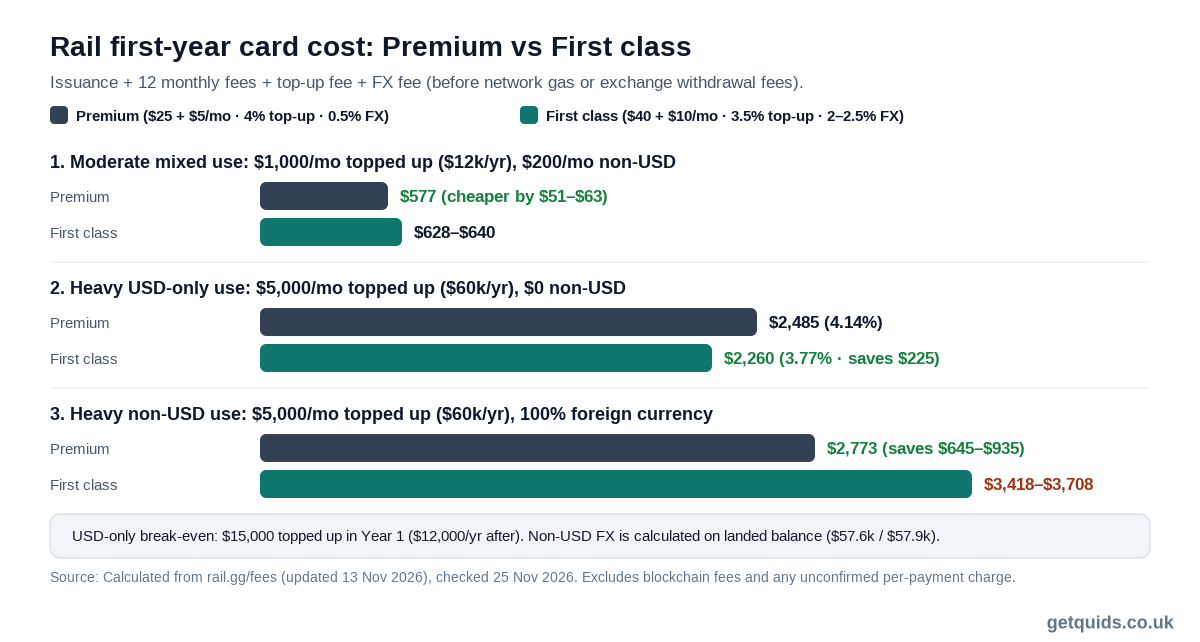
Rail deducts its top-up fee from the crypto amount you send, so landing US$1,000 of spendable balance requires sending US$1,041.67 on Premium (US$41.67 fee, or 4.17% of what you spend) or US$1,036.27 on First class (US$36.27 fee, or 3.63%). Fixed charges add US$85 in Year 1 on Premium (US$25 issuance + 12 x US$5) or US$160 on First class (US$40 + 12 x US$10), before blockchain gas or exchange withdrawal fees.
On pure US-dollar spending, First class's 0.5% lower top-up rate needs US$15,000 of annual top-ups in Year 1 (US$12,000/year after) to beat Premium's extra US$75 Year-1 fixed cost. In three concrete scenarios from rail.gg/fees: (1) topping up US$1,000/month with US$200/month in foreign currency costs US$577 on Premium versus US$628–US$640 on First class; (2) US$5,000/month spent entirely in USD costs US$2,485 on Premium versus US$2,260 on First class (saving US$225); (3) US$5,000/month spent entirely in non-USD currencies costs US$2,773 on Premium (0.5% FX on US$57,600 landed) versus US$3,418–US$3,708 on First class (2–2.5% FX on US$57,900 landed), making Premium US$645–US$935 cheaper abroad.
What our waitlist invite link covers
Opening our Rail invite link sets the referral cookie in your browser and takes you straight to the official waitlist signup form. Rail does not publish any welcome cash bonus, free card issuance or spending cashback for invited users, so treat the link purely as your entry route onto the launch waitlist.
Stay in the same browser session from clicking our link through submitting your email in the Get Rail modal, as the signup screen provides no manual referral-code field.
Fee conflicts, 45-day dormancy and rapid-exit clauses
Our check found direct contradictions inside Rail's own documentation. The official fees page (13 November 2026) lists First class FX at 2–2.5% with no per-payment fee, whereas Rail's 15 November 2026 comparison guide cites 1.5% First class FX in its table (2% in its own worked example) and adds a per-payment fee of US$0.30 on Premium and US$0.10 on First class. Confirm the binding Confirmation screen at launch before paying any non-refundable issuance fee (Terms §7.3).
Two contractual rules also stand out. First, under Part B §B.9.3, if a card has no successful payment for more than 45 continuous calendar days, the card issuer may temporarily or permanently block it, potentially irreversibly. Second, under Part A §10.3.2–10.3.6, depositing US$2,000 or more and initiating a withdrawal or disposal within 48 hours triggers an elevated-risk review; if that review establishes a breach causing costs or losses, Rail can withhold up to 10% of the reviewed funds. Separately, Part F's Rewards Program is an optional locked digital-asset allocation or third-party staking feature with variable unguaranteed rates and full reward forfeiture or clawback on early exit (up to 7 days) — not card cashback.
Custody, deposit protection and lack of user track record
Rail operates a fully custodial prepaid structure. Crypto top-ups go to an unnamed third-party Custodian Wallet and convert into a USD Virtual Account ledger that Terms Part D explicitly defines as not a bank account, payment account, stored value facility or e-money account. Balances pay zero interest, carry no statutory deposit insurance (no FSCS, FDIC, EU DGS or Hong Kong DPS), and Group liability is capped at your current account balance (§14.3).
Because Rail is still in its pre-launch waitlist phase as of 25 November 2026, there are no live Apple App Store or Google Play listings to benchmark user ratings, Trustpilot could not be retrieved directly, and Rail's Telegram channel (@raildotgg) showed 494 subscribers and a single waitlist launch notice. This assessment is desk-researched from Rail's published pages rather than funded first-hand card spending.
Country rules, onboarding and leaving Rail
Rail's 16 November 2026 country guide excludes 31 countries from Premium (Afghanistan, Belarus, Bosnia and Herzegovina, Burundi, Central African Republic, Cuba, DR Congo, Ethiopia, Guinea, Guinea-Bissau, Haiti, Iran, Iraq, Lebanon, Liberia, Libya, Mali, Montenegro, Myanmar, Nicaragua, Niger, North Korea, Russia, Sierra Leone, Somalia, South Sudan, Sudan, Syria, Venezuela, Yemen and Zimbabwe) and excludes Hong Kong residents, citizens, tax residents and visitors from both tiers. First class excludes those same 32 territories plus 9 more: Bangladesh, China, India, Indonesia, Morocco, Nepal, Turkey, Ukraine and the United States.
Although neither tier advertises an upfront ID check, Terms Part A §4.6–4.7 and §13.6 allow Rail to demand identification and source-of-funds documents during onboarding, risk reviews or user-initiated account termination. Termination returns eligible balances via a method Rail selects (subject to return fees and maintenance fees on suspended/terminated accounts), and unclaimed balances may be appropriated after 3 years (§13.10–13.12).
Who should join the waitlist — and who should skip it
Join the free waitlist if you live outside Rail's excluded territories, want to keep an eye on a high-limit virtual card that supports Apple Pay and Google Pay without an upfront ID check (especially US residents who have few no-KYC options), and plan to check the final fee schedule and named card issuer before paying anything at launch.
Skip Rail if you live in Hong Kong or another excluded country, want a sign-up bonus or spending cashback, need ATM cash withdrawals or a physical card, want lower 0%–1% stablecoin spend costs via a standard KYC or self-custody card, or will not fund an account whose legal entity and card issuer remain unnamed.
FAQ
- Is Rail live right now, or only taking waitlist sign-ups?
- As of 25 November 2026, Rail is still in its waitlist phase. Clicking Get Rail collects your email to notify you when cards open, with no announced general release date for virtual or physical cards.
- Does Rail really require no ID check (KYC)?
- Rail advertises no upfront ID check on either Premium or First class. However, Terms Part A §4.6–4.7 and Part B §B.9.1(c) explicitly reserve the right to demand identity documents, proof of funding sources and compliance verification at any time, including on account termination.
- Why does Rail's fees page disagree with its comparison article?
- rail.gg/fees (13 November 2026) lists 2–2.5% FX on First class and no per-payment fee, while Rail's 15 November 2026 guide lists 1.5% FX in its summary table (2% in an example) plus US$0.30/US$0.10 per-payment fees. Check the live fee schedule and issuance Confirmation before paying the non-refundable issuance fee.
- Is Rail available in Hong Kong, the United States or the UK?
- Hong Kong residents, citizens, tax residents and visitors are excluded from both tiers despite the Terms running under Hong Kong law. US residents are eligible for Premium only (not First class). The UK is not on Rail's blocklist, though GetQuids suppresses crypto card offers for UK visitors.
- Does Rail pay cashback or offer a welcome bonus?
- No. Rail pays 0% cashback on card purchases and publishes no invitee sign-up bonus or fee discount. The separate Rewards Program in Terms Part F is an optional digital-asset lockup/staking feature with variable, unguaranteed rewards.
- Can I withdraw cash from an ATM or get a physical Rail card?
- No ATM withdrawals are listed and both tiers are virtual-only today. Rail states a physical card is planned, with no date, fee or tier announced.
- Who is the legal operator behind Rail and are funds insured?
- Neither the Terms of Use nor Privacy Policy names a registered legal entity, address, card issuer or custodian. Balances sit in a custodial virtual ledger with zero FSCS, FDIC, EU DGS or Hong Kong DPS deposit protection.
Related offers

Provider
Startale
Startale's self-custodial Visa card began rolling out virtual cards by priority rank on 2 November 2026 via Rain (Third National). Registering through our link with KNEJGM36 reserves your waitlist spot for £0. When your batch opens in the Card tab, a five-minute application with a Sumsub ID check gets you the card, then you fund in USDSC via Default Card Balance and tap with Apple or Google Wallet for 1% USDSC cashback — though up to 1.5% non-USD FX and up to 1.5% cross-border fees outweigh 1% on non-dollar spend.
Requirement: No deposit to hold a queue spot; USDSC top-up needed only upon invite and activation
Easy5 minutesPayout Queue reservation at sign-up; virtual card invites roll out in waves by priority rank
Verified 20 November 2026

Provider
Kem App
Use OSL63TSILX when joining Kem to send and swap crypto and apply for a virtual Visa card. Our application showed a one-off 1 USDT issuance fee.
Requirement: No spend to enter the code. Our virtual card application quoted a one-off 1 USDT fee. The external wallet route said to send at least 5 USDT
MediumOur application took about eight minutes to reach processing. Kem displayed up to 24 hours for the next step.Payout Kem publishes no current invitee payout or timetable.
Verified 20 November 2026

Provider
Solid
Here's the Solid deal: sign up with referral code 2SS2K, get verified and activate the card, then spend $150 on everyday purchases at 3+ different shops ($10+ at each) within 30 days for $10 in card credit. Reach $5,000 within 90 days and another $50 follows. The catch: card credit only pays for Solid card purchases and can't be withdrawn, though it never expires. The free virtual Visa now comes from Wirex, pays 3% USDC cashback on the free Core tier (up to $50 a month) and charges 1.5% on non-dollar spending, so pounds cost extra.
Requirement: Spend $150 at 3+ different shops ($10+ at each) within 30 days for $10; $5,000 within 90 days for another $50
Medium15-30 minutes to open and verify; qualifying spend takes longerPayout Card credit is added once each milestone is reached: $10 for the 30-day spend, $50 more at $5,000 within 90 days; a review can take up to 14 days
Verified 22 November 2026