Do sign-up offers hurt your credit score? Hard and soft searches
By GetQuids· Last verified: 22 November 2026 (HKT)· 11 min read
Which UK bank, switch, credit card, buy now pay later, savings, investing and cashback offers run a hard or soft credit search, how long Experian, Equifax and TransUnion keep it, and how to space your applications.

Ad / referral links — we may earn a bonus when you sign up.
The bonus isn't on your file; the application is
Banks and card issuers don't tell Experian, Equifax or TransUnion that you earned a switching bonus or a pile of welcome points. A referral reward is a payment or a perk, not a credit account. What reaches the credit reference agencies is the check the provider runs when you apply and, later, the account itself if the provider reports it.
There are two kinds of check. A hard search happens when you make a full application for credit: Experian lists loans, credit cards, mortgages, utility accounts and pay-monthly phone contracts. Each one shows on your report and other lenders can see it. A soft search covers identity checks, eligibility checkers and you looking at your own report. Experian says only you can see soft searches and it doesn't matter how many there are.
So every offer comes down to two questions: does applying leave a hard search, and does it open credit? The table sorts the usual UK sign-up offers by both.
Which UK sign-up offers leave a hard search (checked 22 November 2026)
| Offer type | Check when you apply | What lenders see afterwards | What the providers say |
|---|---|---|---|
| App current accounts: Chase, Monzo, Zopa Biscuit | Soft search | A new current account once the bank reports it; no hard search | Chase runs a soft credit search against its credit history criteria. Monzo's soft search can show as a 'quotation search' or 'administration review'. Zopa runs a soft search to verify your identity and says there's no hard credit check |
| High-street switch accounts (CASS) | A credit search, which can be one lenders see | The search, the new account and, after a full switch, your old account shown as closed | CASS says the new bank may run a credit check. Nationwide's current account information says the checks in its applications leave a footprint other lenders can see |
| An overdraft added at opening | Hard search | A credit facility on your file | Nationwide's overdraft tool runs a soft check, then a hard check if you carry on. Monzo leaves a hard check when you open an overdraft |
| Credit cards | Hard search on a full application | The search and a new card account | American Express gives an instant decision without affecting your score; an entry shows on your file only if you're approved and accept the card |
| Buy now, pay later | Soft is more common; some providers use a hard search | Each purchase usually shows as a new credit agreement where the provider reports it | Zilch runs a soft check at sign-up, then reports your limit, usage and repayments every month. Experian says soft checks are more common for BNPL |
| Savings accounts and savings platforms | Identity check, soft at most | Nothing a lender can see | Raisin runs one identity and anti-money-laundering check at registration, shown only as a soft search, then opens partner-bank accounts without further credit checks |
| Investing apps and stocks and shares ISAs | Identity check | Nothing a lender can see | Investment providers verify who you are before you invest; Experian counts a company searching your report as part of an identity check as a soft search |
| Cashback sites and apps | No credit application | Nothing | TopCashback and Quidco pay you for shopping through them; joining isn't an application to borrow |
| Pay-monthly phones and energy | Can be a hard search | The search and the new contract | Experian lists utility and pay-monthly phone applications among its hard-check triggers; Equifax says checks by utility and phone providers are most likely soft unless you agree to a hard search. Ask before you apply |
Providers change their checks, so read the application screen before you submit. Equifax says nobody can run a hard search on you without your permission, so you can stop before you agree to one.
Bank switches: the six-month rule from CASS
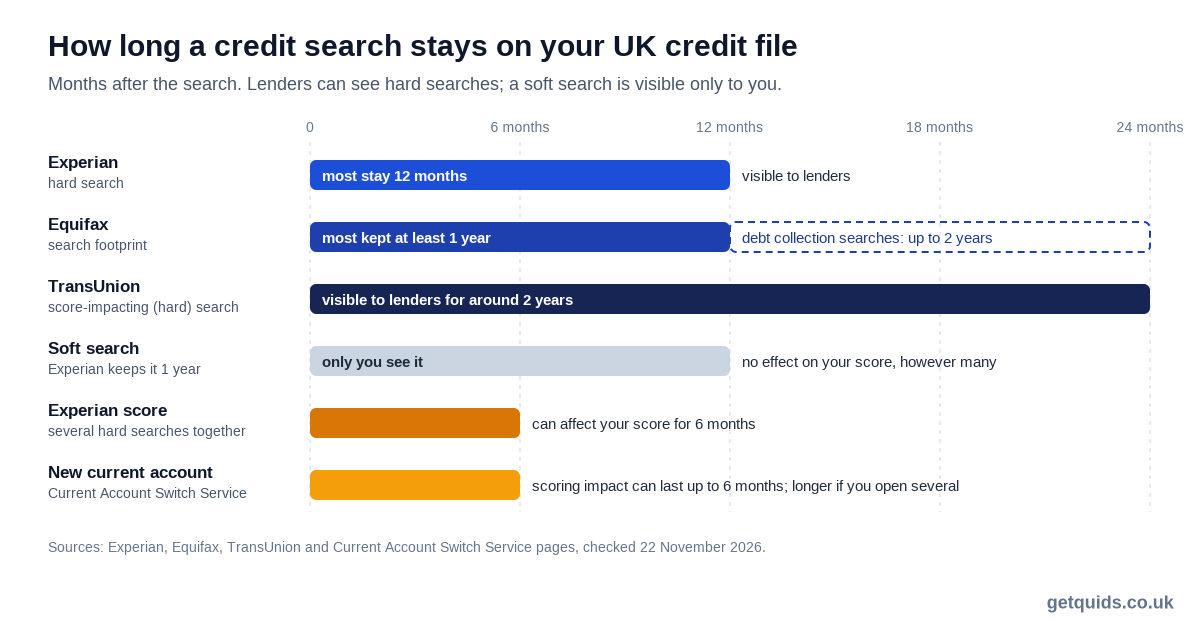
The Current Account Switch Service doesn't look at your credit file; the bank you're joining might. CASS's own answer is that opening a new account can affect your rating, the scoring impact can last up to six months, and opening several accounts within six months means your score takes longer to return to normal. It adds that a full switch closes your old account, which can count in your favour.
Nationwide shows what a lender-visible check looks like: its current account information says the checks in most account applications leave a footprint other lenders can see, which might affect your ability to get credit elsewhere for a short while. Its switch offer pays £175, so the trade is one visible search for the bonus.
Two things make a switch heavier than it needs to be. The first is an overdraft: Nationwide's overdraft tool starts with a soft check and moves to a hard check if you carry on, and TransUnion counts a current account with an overdraft as a financial account, one where credit is available, and one without an overdraft as not. Decline it unless you need it. The second is which account you move. CASS says closing the old account can help; Experian says long-standing, well-managed accounts can help show lenders you manage credit over time, and Equifax keeps closed accounts on your file for six years. If you have a spare or newer current account, switch that one and keep the account you've held for years.
The app accounts are lighter still. Chase, Monzo and Zopa Biscuit open with soft searches, but Monzo points out that lenders can see a new account and that opening lots of accounts in a short space of time can still pull a score down. Open the ones you'll actually use. For the switch bonuses themselves, read the bank-switching guide, what to do when a switch goes wrong and our Chase vs Monzo comparison.
Current-account offers: three soft searches, one switch

Provider
Chase UK

Chase pays you £50 when you activate a single-use referral code in the app and pay in £1,000 in total within 30 days of opening your first account. Chase only lets customers send codes to people they know, so request a private invite from this page rather than relying on a public code. Move the £50 out of Rewards before you ever leave Chase.
Requirement: Activate a personal single-use code and pay in £1,000 in total within 30 days of opening your first Chase account
MediumApproval and invitation availability varyPayout Added to your rewards balance straight away once you reach £1,000 (Chase emails you); redeem it before leaving Chase
Verified 22 November 2026

Provider
Monzo
Monzo's referral terms give a new UK customer 30 days from entering their mobile number on the invite page to open an account, add money and make one card payment. Your reward is random: £10 for 94 people in 100, £20 or £50 for the rest, and only £5 in some cases. Open it for the account, not the bonus.
Requirement: Add money (any amount) and make one eligible Monzo card payment within 30 days
Easy10 minutesPayout No timeframe in the terms: Monzo shows the reward in the app once the referral is complete
Verified 11 October 2026

Provider
Zopa Biscuit

Open a Biscuit bank account through GetQuids' Zopa invite link and you get £20, provided you've never used the Zopa app or held a Zopa product. Enter your mobile number on the invite page first and finish within 30 days; the live invite terms control.
Requirement: None on this invite: open a Biscuit account through the link within 30 days of entering your mobile number
Easy5-10 minutes; opening can take up to 2 working daysPayout Within 30 days of qualifying
Verified 22 November 2026

Provider
Nationwide

Switch a current account from another bank in full, moving at least 2 active Direct Debits, within 28 days; then pay in £1,000 and make one eligible debit-card payment within 31 days. A new or existing FlexDirect, FlexAccount or FlexPlus can qualify; switches from Nationwide or Virgin Money are excluded, and sole and joint bonuses are limited to one each since 2021. Pick the earliest switch date offered.
Requirement: Switch completes within 28 days; £1,000 paid in and one eligible debit-card payment within 31 days of opening or of asking to switch into an existing account
Medium15-20 minutesPayout Within 10 days after all requirements, shown as 'Switching Offer', with the account still open
Verified 11 October 2026
How Experian, Equifax and TransUnion handle searches
| Agency | Hard search | Soft search | Effect on your score | Score scale, November 2026 |
|---|---|---|---|---|
| Experian | Most stay on your report for 12 months, visible to lenders | Only you see it; kept for one year | Too many hard checks in a short period can affect your score for six months | 0 to 1,250 |
| Equifax | Most search footprints kept for at least one year; debt collection searches up to two years | Doesn't affect your credit score | Too many hard searches in a short period may affect your score | Out of 1,000 |
| TransUnion | Score-impacting (hard) searches stay visible to lenders for around two years | Identity and eligibility checks may be visible only to you | One search is unlikely to matter much; several applications close together may be taken into account by lenders | 0 to 999, rolling out since September 2026 in place of 0 to 710 |
Each agency holds its own data and not every lender reports to all three, so a search can show on one file and not another. Every agency's statutory credit report is free. TransUnion's lists the credit searches from the last two years, and Experian says the soft searches only you can see show on your own report.
Credit cards and buy now, pay later
A credit card application is the classic hard search. American Express works differently: you get an instant decision without your score being affected, and an entry shows on your file only if you're approved and accept the card, so a decline leaves nothing for lenders to see. That makes the Amex Gold referral (35,000 pts + £100 gift card, apply by 12 January 2027) a gentle first application. The welcome has its own catches: anyone who has held any personal American Express card in the last 24 months gets no welcome offer, and Amex asks for an income of at least £20,000 a year. The Amex Gold review works out whether the card earns its fee after year one.
Most other card issuers run the hard search when you submit. Try their eligibility checkers first: Experian's checker is a soft search, and TransUnion suggests eligibility checkers before a full application.
Buy now, pay later changed on 15 July 2026, when the FCA started regulating it. Lenders now have to check you can afford to repay before you take out an agreement, while agreements made before that date stay unregulated. Experian calls BNPL a type of credit: soft checks are more common than hard ones, and each new purchase usually shows on your report as a new credit agreement. TransUnion shows it as a 'Deferred Payment' account that lenders can see, but leaves it out of its new score.
Zilch is the BNPL offer here. Its sign-up check is soft, but once the account is open Zilch reports your limit, usage and repayments to the agencies every month, so a missed payment can hurt your score and paying on time can help. The reward is £5 in Rewards; the Zilch review covers the fees.
Credit offers: apply only for credit you'd use

Provider
American Express Preferred Rewards Gold Credit Card

Apply through our referral link by 12 January 2027, get approved and spend £3,000 in your first three months, and Amex adds 35,000 Membership Rewards points plus a £100 Selfridges eGift Card. No fee in year one, then £195; anyone who has held a personal Amex card in the last 24 months gets no bonus.
Requirement: £3,000 on purchases within three months of approval; apply by 12 January 2027
MediumAbout 10 minutes to apply; Amex often decides within a minutePayout Bonus points after you reach £3,000 of spend; the Selfridges eGift Card by email, up to 8 weeks after your first three months
Verified 14 November 2026 · Ends 12 January 2027

Provider
Zilch
Get approved and your card issued within 30 days of signing up through this link, add one small Tap and Pay purchase on Pay now to be safe, and Zilch adds £5 in Rewards within 10 working days. The value is in Pay now at stores you already use; the pay-later side is credit (representative APR 14.9% to 31.9% by tier), and Auto Snooze charges £1 or £2 per failed instalment.
Requirement: Verify your ID, get approved and receive your card within 30 days; the referral page also asks for a first Tap and Pay purchase
Easy5 minutes to sign up; approval and card issue within 30 daysPayout £5 in Rewards within 10 working days of completing the referral tasks
Verified 12 October 2026
Savings, investing and cashback: no credit application
Savings and investment providers check who you are, not whether to lend to you. Raisin says registering runs a single identity and anti-money-laundering check that shows only as a soft search, and you can then open accounts with its partner banks without further credit checks. The Raisin offer pays £100 on a first fixed-rate bond: the catch is locking money away, not your credit file.
Investing apps and stocks and shares ISAs work the same way. They verify your identity before you invest, and when a company searches your report as part of an identity check, Experian treats it as a soft search that lenders never see.
Cashback sites aren't credit either. Joining TopCashback or Quidco doesn't involve applying to borrow, so they sit happily alongside anything else on your list. TopCashback's welcome is £10 welcome.
Offers with no search a lender can see

Provider
Raisin UK

Register through our link as a new Raisin UK customer, then make your first savings account a fixed-rate bond of one year or longer with at least £10,000 in it, opened and funded within 365 days of registering. Raisin pays you £100 within 28 days of opening and funding, with no claim needed. Bond money is normally locked until maturity, so compare the rate and term first.
Requirement: At least £10,000 in one first qualifying fixed-rate bond for one year or longer, opened and funded within 365 days of registering
MediumApproval time varies; up to 2 business days to open after fundingPayout Within 28 days of opening and funding the qualifying bond; no claim needed
Verified 22 November 2026

Provider
TopCashback
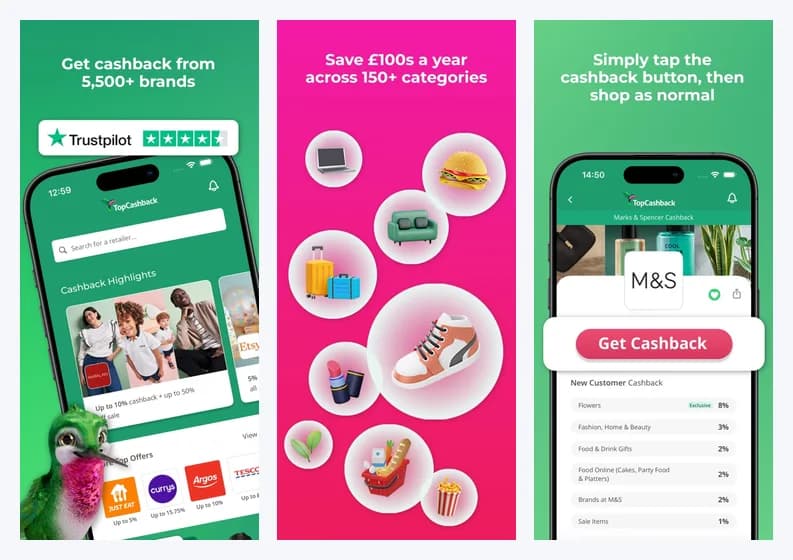
The UK cashback institution. Join TopCashback via the referral link and earn £10 of approved cashback within 180 days of joining to unlock a £10 bonus — the operative word is approved: tracked is not confirmed, and the retailer has to validate the sale first, so patience is required. Then keep earning across 5,500+ retailers, withdrawing to your bank, PayPal or gift cards (which sometimes carry a top-up bonus). New accounts start on Plus (£5 a year taken from cashback); switch to the free Classic tier before you start earning if you don't want it. Cashback can take weeks or months to confirm — that's just how the game works.
Requirement: Earn £10 of approved cashback at eligible brands within 180 days of joining
Easy5 minutesPayout Once £10 of qualifying cashback is approved; the bonus is paid by bank transfer
Verified 17 November 2026
How many applications is too many?
None of the three agencies publishes a number, and every lender sets its own criteria. Experian comes closest: its guide to improving your score gives a rule of thumb of no more than one application every three months, and its credit-check guide allows two or three every few months. The reason is the same in both: lots of applications close together can make lenders think you're relying on credit or in financial trouble.
Count only the searches lenders can see: credit cards, overdrafts, loans, switch accounts that hard search, and the phone or energy contracts that do. Soft-search accounts, savings, investing and cashback don't add to the count, though a new current account still shows on your file once the bank reports it.
Two moments matter more than the count. Before a mortgage, Experian advises against applying for credit in the six months before your application. After a refusal, find out why before you try again: Experian says it isn't told when you're refused, while the hard search from each application stays on your report, so a run of quick reapplications only adds footprints.
Worked example: a year of sign-up offers before a mortgage
| When | What you do | Check | Lender-visible items added |
|---|---|---|---|
| Before you start | Get your free statutory reports from Experian, Equifax and TransUnion and fix any errors | None | 0 |
| Month 0 | Open the app accounts you'll use (Chase, Monzo, Zopa Biscuit), join TopCashback, and register with Raisin if you have savings to fix | Soft searches and identity checks | 0 searches; the new current accounts appear on your file within about 4 to 6 weeks |
| Month 1 | Nationwide switch from a spare current account, overdraft declined | A footprint other lenders can see | 1 |
| Month 4 | Amex Gold, if the card suits your spending | Instant decision without a score effect; entry once you accept | 1 (the card) |
| Months 6 to 12 | No new credit, overdrafts or hard-search switches; cashback and savings offers carry on | None | 0 |
| Month 12 | Mortgage application | Hard search by the mortgage lender | In the past 12 months: 2 |
Assumptions: an established UK credit file with no missed payments, no overdraft needed, and each product is one you'd choose anyway. Zilch is left out because, although its sign-up check is soft, it opens a credit account reported every month; if you'll use it, add it before month 6. At month 12 the month-1 search is 11 months old, so it is still inside every agency's retention period.
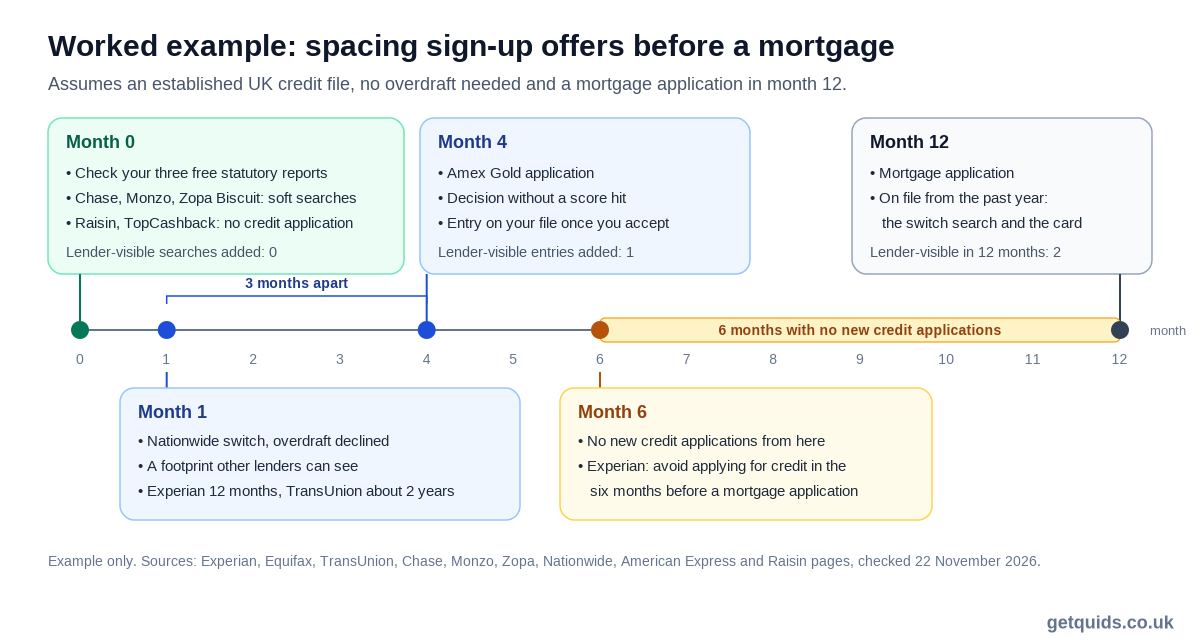
A sensible order for stacking UK sign-up offers
- Check your statutory reports from all three agencies first. They're free, and an error is easier to fix before you apply than after a refusal.
- Start with the offers that leave nothing for lenders to see: soft-search current accounts, savings platforms, investing apps and cashback sites.
- Then make one hard-search application at a time, about three months apart: a switch, a credit card or a phone contract.
- Look for the soft step first: an eligibility checker, Amex's decision without a score effect, or an overdraft tool that quotes before it searches.
- Turn down an overdraft you don't need when you open or switch an account.
- Switch a spare or newer current account rather than the one you've had for years.
- Stop new credit applications six months before a mortgage application, and after a refusal wait until you know the reason.
- Check your reports again about six weeks after each new account: TransUnion says new account information usually takes 4 to 6 weeks to appear.
FAQ
- Do sign-up bonuses affect your credit score?
- The bonus itself doesn't: no agency is told you earned a reward. The application can, if the provider runs a hard search, and so can the new account once it's reported. Soft-search accounts, savings, investing and cashback offers leave nothing a lender can see.
- Does switching bank account affect your credit score?
- It can. CASS says the new bank may run a credit check, the impact of opening an account can last up to six months, and several new accounts in six months take longer to recover from. The full switch closes your old account, which CASS says can help.
- Which UK bank accounts open with a soft search?
- Chase runs a soft credit search, Monzo a soft search that can show as a quotation search or administration review, and Zopa a soft search to verify your identity with no hard credit check. Adding an overdraft changes things: Monzo leaves a hard check when you open one.
- How long does a hard search stay on my credit file?
- Most stay 12 months on Experian. Equifax keeps most search footprints for at least a year and debt collection searches for up to two. TransUnion keeps score-impacting searches visible to lenders for around two years.
- How many credit applications are too many?
- There's no official limit. Experian's rule of thumb is no more than one application every three months, and none in the six months before a mortgage application. Count only the searches lenders can see.
- Does buy now, pay later show on my credit file?
- Often, yes. Since 15 July 2026 BNPL lenders are FCA-regulated and must check you can afford to repay. Experian says each purchase usually shows as a new credit agreement where the provider reports it; TransUnion shows it to lenders as a Deferred Payment account but leaves it out of its new score.
- Will opening a savings account or ISA hurt my credit score?
- No. Savings and investment providers check your identity, which is a soft search at most. Raisin says registering leaves a single soft search, and you can then open partner-bank accounts without further credit checks.
- Does a declined application show on my credit report?
- The refusal doesn't: Experian says it isn't told when you're refused. The hard search from the application stays, so find out why before you reapply.